HIPAA —
HIPAA Compliance Checklist: 8 Steps to Protect Patient Data
Follow this 8-step HIPAA compliance checklist to safeguard patient data, avoid costly penalties, and meet all privacy and security requirements.
DSALTA Team
HIPAA Compliance Essentials
Share this article


HIPAA Compliance Checklist: 8 Steps to Protect Patient Data
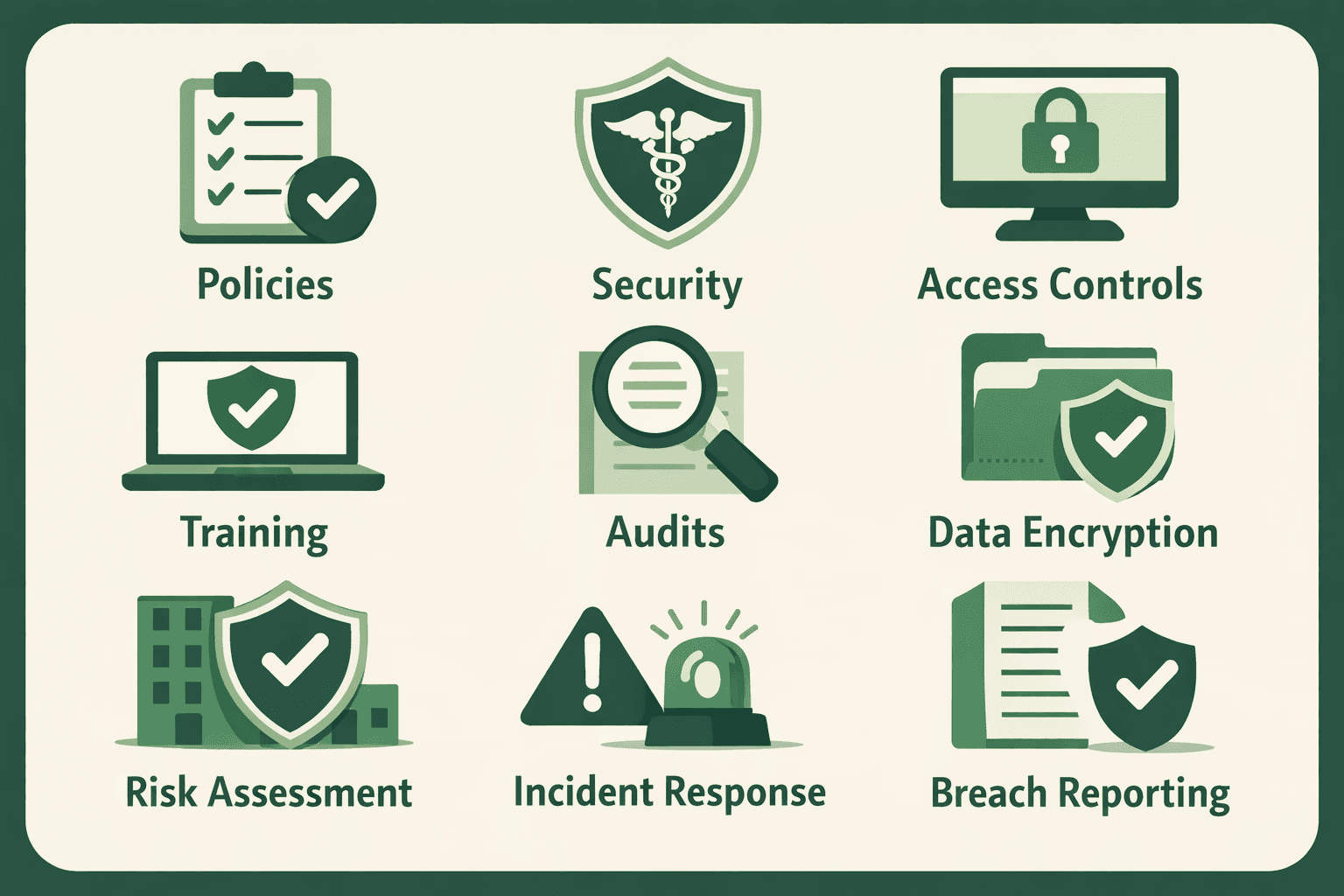
Achieving HIPAA compliance doesn't have to be overwhelming. Whether you're a healthcare provider, business associate, or AI-powered health tech company, following a structured HIPAA compliance checklist ensures you meet all privacy and security requirements — and avoid penalties that can reach millions of dollars.
This guide walks you through 8 essential steps to build a HIPAA-compliant organization from the ground up.
What Is HIPAA Compliance and Why Does It Matter?
The Health Insurance Portability and Accountability Act (HIPAA) sets the federal standard for protecting sensitive patient health information (PHI). Any organization that handles, stores, or transmits PHI — including AI compliance platforms, healthcare apps, and third-party vendors — must meet HIPAA's Privacy Rule, Security Rule, and Breach Notification Rule.
Non-compliance can result in fines ranging from $100 to $50,000 per violation, reputational damage, and loss of patient trust. A clear HIPAA compliance checklist removes guesswork and keeps your organization audit-ready year-round.
The 8-Step HIPAA Compliance Checklist
Step 1: Identify All Protected Health Information (PHI) You Handle
Before you can protect patient data, you need to know exactly where it lives.
Audit all data flows across your systems, applications, and third-party vendors
Identify electronic PHI (ePHI), physical PHI, and verbal PHI
Document who has access to PHI and why
Map data from collection to storage to disposal
Pro Tip: AI-driven compliance tools like DSALTA can automate PHI discovery and continuously monitor your data environment for new exposures.
Step 2: Conduct a Thorough Risk Assessment
HIPAA's Security Rule requires covered entities to perform a formal, documented risk analysis — this is the single most critical step in the entire checklist.
Identify potential threats and vulnerabilities to ePHI
Evaluate the likelihood and impact of each risk
Document findings in a written risk assessment report
Review and update the assessment at least annually or after major system changes
A risk assessment isn't a one-time event. It should be a living process embedded into your compliance program.
Step 3: Implement a Risk Management Plan
Once risks are identified, you must act on them. HIPAA requires covered entities to reduce risks to a "reasonable and appropriate" level.
Prioritize high-impact vulnerabilities first
Assign remediation owners and deadlines
Implement technical, administrative, and physical safeguards
Track remediation progress and document completed actions
For organizations managing multiple vendors, a robust third-party risk management framework ensures your entire supply chain meets HIPAA standards.
Step 4: Establish HIPAA Policies and Procedures
Written policies are the backbone of HIPAA compliance. They provide a repeatable, auditable framework for how your organization handles PHI.
Your policy library should include:
Privacy Policy covering patient rights and PHI use limitations
Security Policy covering ePHI access controls and incident response
Breach Notification Policy outlining response timelines (72 hours for covered entities)
Workforce Sanction Policy for employees who violate HIPAA rules
Acceptable Use Policy for devices and systems that access PHI
Review and update all policies annually or when regulations change. Learn more about HIPAA policies and procedures requirements.
Step 5: Train Your Entire Workforce on HIPAA Requirements
Human error is the leading cause of healthcare data breaches. HIPAA mandates workforce training as a non-negotiable requirement — not just for clinical staff, but for every employee who touches PHI in any form.
Deliver role-based HIPAA training during onboarding and annually thereafter
Cover phishing awareness, password hygiene, and device security
Maintain training completion records for audit purposes
Test employee knowledge through quizzes or simulated phishing exercises
Explore our complete guide on HIPAA training for employees in 2025 to build an effective training program.
Step 6: Manage Business Associate Agreements (BAAs)
If you share PHI with any third-party vendor — cloud storage, billing software, AI tools, or analytics platforms — you are required to have a signed Business Associate Agreement (BAA) in place before any data is exchanged.
Inventory all vendors and partners who access or process PHI
Ensure every vendor has a current, signed BAA on file
Review BAAs when vendor services or your data practices change
Terminate relationships with vendors who refuse to sign a BAA
Note: DSALTA helps AI-driven organizations identify which vendor relationships require BAA and automatically flags gaps in your third-party compliance posture. Understanding what Business Associate Agreements cover is critical for vendor risk management.
Step 7: Implement Technical Safeguards for ePHI
The HIPAA Security Rule outlines specific technical controls required to protect electronic PHI. These are non-negotiable for any organization operating in digital environments.
Required technical safeguards include:
Access Controls: Unique user IDs, automatic logoff, and encryption/decryption protocols
Audit Controls: Hardware and software mechanisms that record and examine activity in systems containing ePHI
Integrity Controls: Measures to ensure ePHI is not improperly altered or destroyed
Transmission Security: Encryption of ePHI in transit using TLS or equivalent standards
Multi-Factor Authentication (MFA): For all systems that store or access ePHI
For AI-powered tools and platforms handling health data, encryption at rest and in transit is especially critical. See how data security compliance controls apply across healthcare and finance sectors.
Step 8: Build a Breach Response and Notification Plan
Even with the best safeguards, breaches can happen. HIPAA's Breach Notification Rule requires covered entities to notify affected individuals within 60 days of discovery, and the Department of Health and Human Services (HHS) within 60 days as well. Breaches affecting 500+ individuals in a state also require media notification.
Your breach response plan should include:
A designated incident response team with clear roles
A step-by-step process for detecting, containing, and investigating breaches
Templates for notifying patients, HHS, and media (if applicable)
A post-incident review process to prevent recurrence
Regular breach simulation drills to test your response readiness
Review the full HIPAA breach notification compliance guide for detailed response workflows and notification templates.
HIPAA Compliance Checklist: Quick Summary Table
Step | Action Item | Frequency |
|---|---|---|
1 | PHI Inventory & Data Mapping | Annually + on change |
2 | Risk Assessment | Annually + on change |
3 | Risk Management Plan | Ongoing |
4 | Policies & Procedures | Annually |
5 | Workforce Training | Annually + onboarding |
6 | Business Associate Agreements | Per vendor relationship |
7 | Technical Safeguards | Ongoing monitoring |
8 | Breach Response Plan | Annually + after incidents |
Common HIPAA Compliance Mistakes to Avoid
Even well-intentioned organizations make costly errors. Watch out for:
Skipping the risk assessment — the most cited HIPAA violation in HHS audits
Outdated BAAs — vendor contracts that don't reflect current data practices
Undertrained staff — employees who click phishing links or mishandle PHI
No audit logs — inability to detect unauthorized ePHI access
Assuming SaaS vendors are automatically compliant — always verify and get a signed BAA
How DSALTA Simplifies HIPAA Compliance
HIPAA compliance is a continuous process, not a checkbox exercise. DSALTA's AI-powered compliance platform helps healthcare organizations and their technology partners:
Automate risk assessments and gap analysis
Monitor PHI exposure across cloud and on-premise environments
Track policy acknowledgments and training completion
Flag missing or expiring Business Associate Agreements
Generate audit-ready compliance reports in minutes
Whether you're preparing for a HIPAA audit or building compliance into a new AI health product, DSALTA gives your team the visibility and control to stay ahead of regulatory requirements.
Frequently Asked Questions About HIPAA Compliance
Who needs to be HIPAA compliant?
Any covered entity (hospitals, clinics, health plans, healthcare clearinghouses) or business associate (vendors, SaaS platforms, AI tools) that creates, receives, maintains, or transmits PHI must comply with HIPAA.
How often should I update my HIPAA compliance program?
At a minimum, conduct a full review annually. Additionally, update your program whenever there is a significant change in operations, technology, staffing, or regulations.
What is the penalty for HIPAA non-compliance?
Penalties are tiered from $100 to $50,000 per violation, with an annual cap of $1.9 million per violation category. Willful neglect with no correction can result in criminal charges.
Is HIPAA compliance required for AI tools used in healthcare?
Yes. Any AI tool that processes, stores, or transmits PHI on behalf of a covered entity qualifies as a business associate and must comply with HIPAA's Security and Privacy Rules — and must sign a BAA.
Final Thoughts
A structured HIPAA compliance checklist transforms a complex regulatory obligation into a manageable, repeatable program. By following these 8 steps — from PHI discovery through breach response — your organization builds the foundation for lasting compliance, patient trust, and audit readiness.
Ready to automate your HIPAA compliance program? Talk to a DSALTA compliance expert today →
Explore more HIPAA articles
Stop losing deals to compliance.
Get compliant. Keep building.
Join 100s of startups who got audit-ready in days, not months.