SOC 2
Cyber Compliance for SaaS: Ransomware Defense, Continuous Monitoring & DORA/ISO 27001 Evidence Gathering
Written by
DSALTA Team
|
Published on
Feb 3, 2026
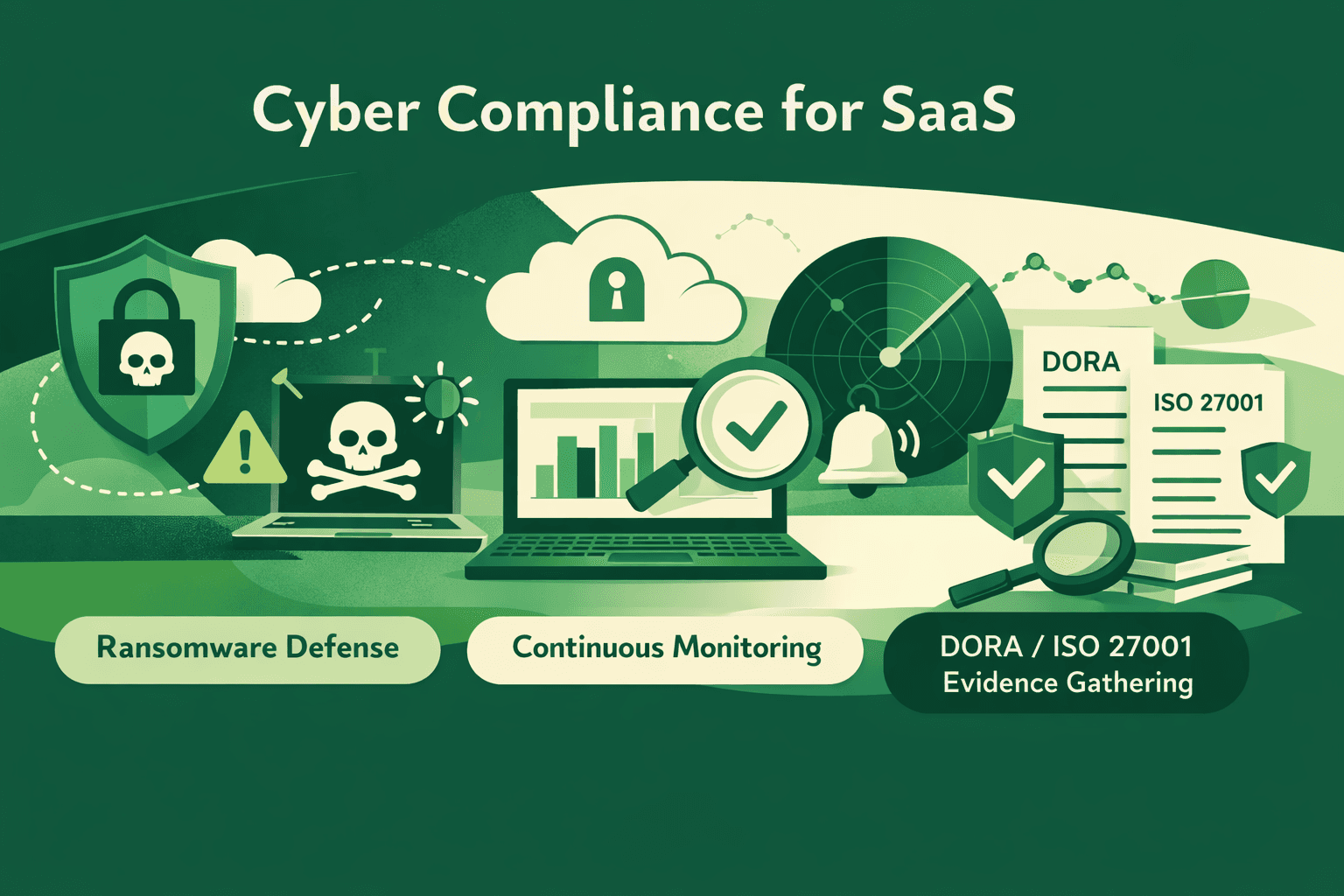
In today's digital landscape, cyber compliance for SaaS companies isn't optional—it's essential. With remote-first teams scaling rapidly and cyber threats evolving, SaaS businesses face unique challenges in maintaining robust security postures while meeting regulatory requirements.
Whether you're preparing for ISO 27001 certification, navigating DORA compliance, or strengthening your ransomware defenses, this guide covers everything you need to know about building a compliance-ready security framework.
Why Cyber Compliance Matters for SaaS Companies
SaaS organizations handle sensitive customer data across cloud environments, making them prime targets for cyberattacks. Ransomware attacks have increased by over 150% in recent years, with SaaS providers particularly vulnerable due to their distributed infrastructure.
Beyond security risks, compliance failures can result in:
• Heavy financial penalties and regulatory fines
• Loss of customer trust and reputation damage
• Inability to close enterprise deals requiring certifications
• Legal liability for data breaches
For remote-first companies, the challenge intensifies as traditional perimeter-based security models no longer apply.
Building Ransomware Defenses for Remote SaaS Teams
Ransomware protection begins with understanding that prevention, detection, and recovery must work together seamlessly.
Essential Ransomware Defense Strategies
Implement Zero Trust Architecture
Zero trust assumes no user or device is trustworthy by default. For remote teams, this means:
• Multi-factor authentication (MFA) on all systems
• Least privilege access controls
• Network segmentation to contain potential breaches
• Regular access reviews and deprovisioning
Maintain Immutable Backups
Your backup strategy is your last line of defense. Best practices include:
• 3-2-1 rule: Three copies of data, two different media types, one offsite
• Immutable or air-gapped backups that ransomware cannot encrypt
• Regular restore testing to verify backup integrity
• Automated backup monitoring and alerting
Deploy Endpoint Detection and Response (EDR)
With distributed teams, every laptop becomes a potential entry point. EDR solutions provide:
• Real-time threat detection on all devices
• Automated response to suspicious activities
• Forensic data for incident investigation
• Cloud-native integration for remote workers
Security Awareness Training
Human error remains the weakest link. Regular training should cover:
• Phishing identification and reporting procedures
• Safe browsing and download practices
• Password hygiene and credential management
• Incident reporting protocols
Continuous Monitoring Setup for SaaS Compliance
Continuous monitoring transforms compliance from a point-in-time audit to an ongoing practice, essential for frameworks such as ISO 27001 and DORA.
Implementing Effective Continuous Monitoring
Security Information and Event Management (SIEM)
A SIEM platform centralizes log collection and analysis across your infrastructure:
• Aggregates logs from cloud services, applications, and endpoints
• Correlates events to identify potential security incidents
• Generates alerts for suspicious activities
• Provides audit trails for compliance evidence
Cloud Security Posture Management (CSPM)
For SaaS companies operating in AWS, Azure, or GCP, CSPM tools:
• Continuously scan cloud configurations for misconfigurations
• Identify compliance violations against security benchmarks
• Automate remediation of common issues
• Track configuration changes and drift
Vulnerability Management Programs
Systematic vulnerability scanning should include:
• Weekly automated scans of all internet-facing assets
• Monthly internal network vulnerability assessments
• Patch management tracking and enforcement
• Integration with development pipelines for shift-left security
Key Performance Indicators (KPIs) to Monitor
Track these metrics to demonstrate continuous compliance:
• Mean time to detect (MTTD) security incidents
• Mean time to respond (MTTR) to vulnerabilities
• Percentage of systems with current patches
• Number of failed access attempts
• Backup success rates and recovery time objectives
DORA Compliance for Financial Services SaaS
The Digital Operational Resilience Act (DORA) applies to financial entities and their critical ICT service providers, including many SaaS vendors.
Key DORA Requirements for SaaS Providers
ICT Risk Management
DORA mandates comprehensive frameworks covering:
Risk identification and assessment methodologies
Security policies and procedures documentation
Change management and configuration controls
Business continuity and disaster recovery planning
Incident Management and Reporting
Financial regulators require detailed incident response capabilities:
Classification criteria for ICT-related incidents
Reporting obligations to authorities within strict timeframes
Root cause analysis and remediation tracking
Communication protocols with affected entities
Digital Operational Resilience Testing
DORA requires regular testing programs, including:
Annual penetration testing by independent third parties
Scenario-based testing for critical operations
Red team exercises for significant institutions
Recovery time and recovery point objective validation
Third-Party Risk Management
For SaaS companies with subprocessors, DORA demands robust third-party risk management:
Due diligence on all critical ICT providers
Contractual arrangements addressing resilience requirements
Ongoing monitoring of third-party performance
Exit strategies for critical dependencies
ISO 27001 Evidence Gathering for Remote Teams
ISO 27001 certification requires demonstrating systematic information security management across your organization.
Building Your Evidence Repository
Documentation Requirements
Your Information Security Management System (ISMS) documentation should include comprehensive policies and procedures. Learn more about ISO 27001 requirements:
Information security policy approved by leadership
Risk assessment methodology and current risk register
Statement of Applicability documenting control implementation
Procedures for all implemented controls (93 controls in Annex A)
Automated Evidence Collection
Modern tools can streamline evidence gathering:
Screenshot and activity logging tools for access reviews
Configuration management databases tracking asset inventory
Ticketing systems documenting incident response
HR systems are proving the security awareness training completion
Control Evidence Examples
For common ISO 27001 controls, gather:
Access Control (A.9): Access request forms, approval workflows, quarterly access reviews, termination checklists
Cryptography (A.10): Encryption policies, key management procedures, TLS configuration screenshots, encryption-at-rest evidence
Physical Security (A.11): For remote teams, evidence of secure home office guidelines, device inventory, and encrypted disk policies
Operations Security (A.12): Change management tickets, backup logs, anti-malware reports, vulnerability scan results
Communications Security (A.13): Network diagrams, firewall rules, segmentation documentation, VPN usage logs
Managing Evidence for Remote Audits
With distributed teams, virtual audits are now standard:
Centralize all evidence in a shared, access-controlled repository
Maintain version control and change logs for documentation
Use screenshot tools to capture the control implementation
Create a traceability matrix linking evidence to specific controls
Practical Implementation Roadmap
Phase 1: Foundation (Months 1-3)
Conduct a comprehensive risk assessment
Deploy EDR and SIEM solutions
Implement MFA across all systems
Establish backup and recovery procedures
Document core security policies
Phase 2: Enhancement (Months 4-6)
Roll out a security awareness training program
Implement continuous vulnerability scanning
Deploy CSPM for cloud infrastructure
Establish incident response playbooks
Begin evidence collection automation
Phase 3: Certification (Months 7-12)
Complete ISO 27001 or DORA gap analysis
Remediate identified control gaps
Conduct an internal audit
Engage the certification body for an external audit
Achieve certification and plan continuous improvement
Common Challenges and Solutions
Challenge: Limited security team capacity in small SaaS startups
Solution: Leverage managed security services (MSSP) and automated compliance platforms like DSALTA to handle continuous monitoring and evidence collection
Challenge: Keeping remote employees compliant with security policies
Solution: Implement device management (MDM/UEM), automated compliance checking, and regular communication about the security importance
Challenge: Demonstrating continuous compliance between annual audits
Solution: Deploy automated compliance monitoring tools that track control effectiveness in real-time and alert on deviations
Challenge: Managing compliance across multiple frameworks simultaneously
Solution: Map controls across frameworks (ISO 27001, SOC 2, DORA share many requirements) and implement once to satisfy multiple standards
Tools and Technologies to Consider
Security Operations
Leading platforms include Splunk, Datadog, Elastic Security, Microsoft Sentinel for SIEM capabilities, and CrowdStrike, SentinelOne, and Microsoft Defender for endpoint protection.
Compliance Automation
Purpose-built compliance platforms like DSALTA, Vanta, Drata, and Secureframe automate evidence collection and continuously monitor control effectiveness.
Cloud Security
Cloud-native security tools such as Wiz, Orca Security, Prisma Cloud, and native cloud provider tools (AWS Security Hub, Azure Security Center, GCP Security Command Center) help maintain secure configurations.
Vulnerability Management
Comprehensive vulnerability scanning is available through Tenable, Qualys, Rapid7, and integrated scanning in developer tools.
Conclusion
Cyber compliance for SaaS companies operating in remote-first environments demands a modern approach that combines automated monitoring, robust ransomware defenses, and systematic evidence gathering. Whether you're pursuing ISO 27001 certification, meeting DORA requirements, or simply strengthening your security posture, the key is treating compliance as an ongoing practice rather than a one-time project.
By implementing continuous monitoring, leveraging automation where possible, and maintaining comprehensive documentation, SaaS companies can build resilient security programs that protect customer data while enabling business growth.
Ready to streamline your cyber compliance journey? Learn how DSALTA helps SaaS companies automate compliance monitoring and evidence gathering for ISO 27001, DORA, and other frameworks.
Continue Reading

SOC 2 in 3 Months: Proven Hacks and Mock Audit Templates to Fast-Track Compliance
Compliance
HR Audit Prep: DEI, Harassment & Compliance Playbook Guide
Compliance
Cyber Compliance for SaaS: Ransomware Defense, Continuous Monitoring & DORA/ISO 27001 Evidence Gathering
How to Master Third-Party Risk Management: A Complete Guide to Vendor Compliance