Vendor Risk Management Software - Ultimate Guide
Written by
Deepika
Published on
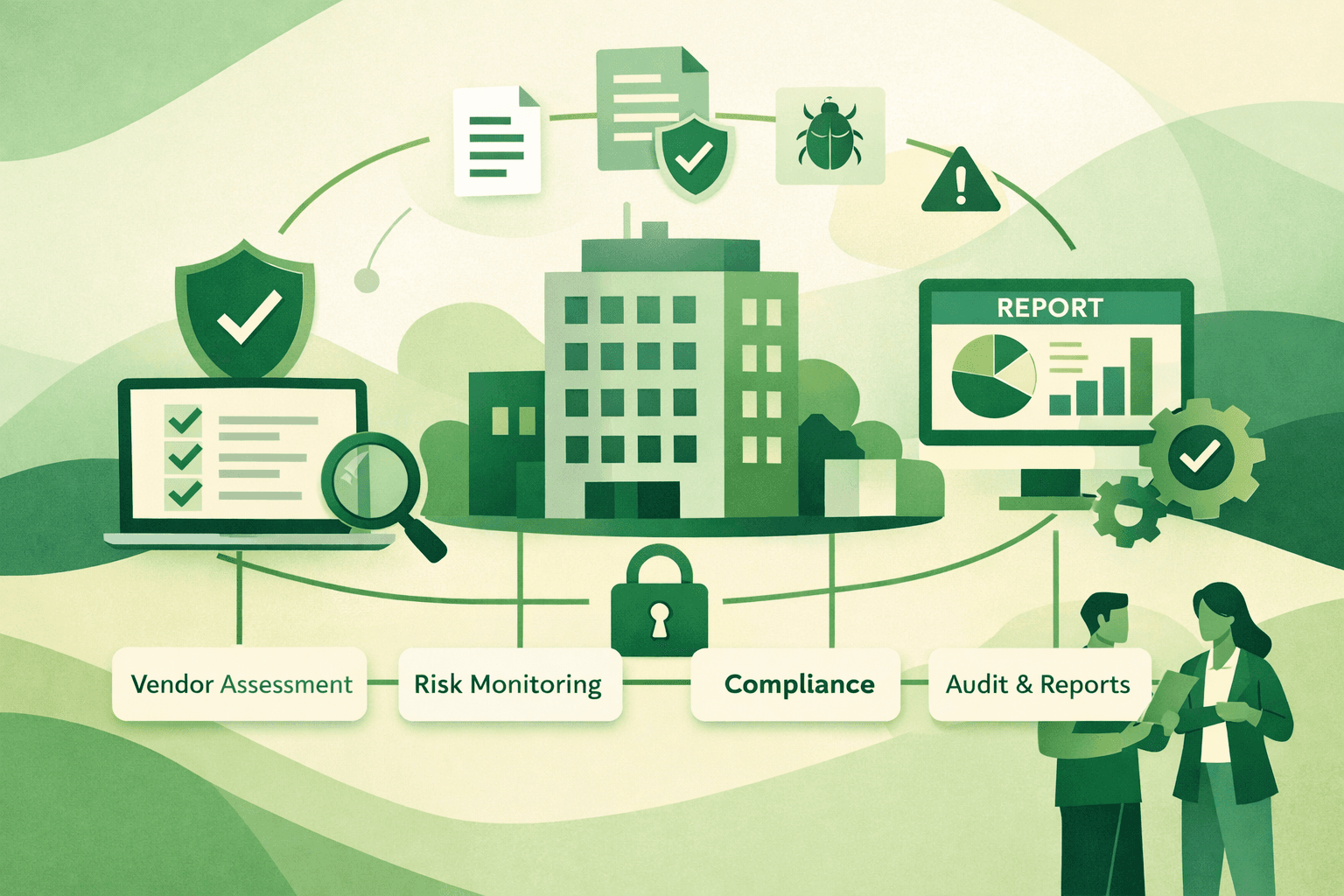
Introduction: Why Vendor Risk Management Software Matters More Than Ever
The average organization works with over 5,800 third-party vendors. Each one represents a potential security risk. In 2024, 45% of data breaches involved a third-party vendor, making vendor risk management one of the most critical security priorities for organizations of all sizes.
Whether you're a startup handling your first SOC 2 audit or an enterprise managing hundreds of vendor relationships, the question isn't if you need vendor risk management software—it's which solution fits your specific needs and budget.
The challenge? The vendor risk management software market has exploded with options ranging from $5,000 annual platforms for startups to $500,000+ enterprise solutions. Features vary dramatically, and choosing the wrong tool can result in budget waste, compliance failures, or security gaps that put your business at risk.
This comprehensive guide breaks down exactly what vendor risk management software does, which features matter at different stages of the company, how pricing models work, and how to choose the right solution for your organization in 2026.
What Is Vendor Risk Management Software?
Vendor risk management software automates and streamlines the assessment, monitoring, and management of security risks posed by third-party vendors, suppliers, and service providers.
The Core Problem It Solves
Managing vendor risk manually becomes impossible as you scale. Spreadsheets used to track vendor assessments quickly become outdated. Security questionnaires sit in email folders. Renewal dates get missed. SOC 2 reports expire without anyone noticing. Critical vendors operate without proper security reviews.
Vendor risk management software centralizes all vendor information, automates assessment workflows, continuously monitors vendor security posture, alerts you to expiring documentation, and generates audit-ready evidence for compliance frameworks.
Who Needs Vendor Risk Management Software?
Startups pursuing SOC 2 compliance need basic vendor inventory and assessment capabilities to satisfy auditor requirements without hiring dedicated vendor risk staff.
Growing companies with 50-200 vendors require workflow automation, standardized assessments, and procurement system integrations to manage vendor risk efficiently.
Mid-market organizations managing compliance across multiple frameworks need cross-framework mapping, advanced risk scoring, and vendor segmentation capabilities.
Enterprises with hundreds or thousands of vendors demand sophisticated automation, AI-powered risk intelligence, continuous monitoring, fourth-party risk assessment, and deep integration with enterprise systems.
Vendor Risk Management Software Features: What Actually Matters
Essential Features Every Organization Needs
Vendor inventory management provides centralized databases that track all vendors, including contact information, contract details, data access levels, and risk classifications. Without a comprehensive inventory, you can't manage risk effectively.
Security questionnaire automation streamlines distribution, completion tracking, and response analysis for security assessments. Look for prebuilt questionnaires aligned with common frameworks such as SOC 2, ISO 27001, and HIPAA.
Document repository stores vendor security documentation, including SOC 2 reports, ISO certificates, penetration test results, and insurance certificates. The system should alert you when documents expire.
Risk scoring and classification assign risk levels to vendors based on data access, operational criticality, and inherent risk factors. Tiered risk levels drive assessment frequency and depth.
Assessment workflow management automates assessment requests, tracks completion status, routes for approvals, and schedules reassessments based on risk tier and elapsed time.
Compliance mapping shows which vendors support which compliance requirements across SOC 2, ISO 27001, HIPAA, and other frameworks your organization pursues.
Advanced Features for Growing Organizations
Integration capabilities connect vendor risk platforms with procurement systems, contract management tools, identity providers, and ticketing systems. Seamless data flow eliminates manual entry and keeps information up to date.
Automated evidence collection pulls vendor security documentation directly from trusted sources, verifies authenticity, and alerts when documentation approaches expiration.
Customizable assessment templates let you create risk assessments tailored to specific vendor types, risk levels, or industry requirements, beyond standard questionnaires.
Vendor portal access enables vendors to update their own information, upload current documentation, and complete assessments through self-service portals, reducing your administrative burden.
Reporting and analytics provide executive dashboards showing vendor risk distribution, assessment completion rates, high-risk vendor counts, and compliance coverage gaps.
Collaboration features support internal teams working together on vendor assessments with commenting, task assignment, approval workflows, and audit trails.
Enterprise-Grade Features for Large Organizations
Continuous monitoring tracks vendor security posture in real time via data feeds, security rating services, breach databases, and news monitoring, rather than relying solely on periodic assessments.
AI-powered risk intelligence analyzes vendor responses, security documentation, and external data sources to identify inconsistencies, flag high-risk areas, and recommend risk treatments.
Fourth-party risk management extends visibility beyond direct vendors to subcontractors and downstream service providers that your vendors use.
Automated remediation workflows create and track corrective action plans when vendor assessments reveal security gaps, and monitor progress toward closure.
Contract lifecycle integration connects vendor risk data with contract negotiations, renewals, and terminations, ensuring risk informs procurement decisions.
Custom risk frameworks allow enterprises to define proprietary risk methodologies, scoring algorithms, and assessment criteria aligned with organizational risk appetite.
Advanced role-based access provides granular permissions controlling who can view, assess, approve, or modify vendor information across different business units or geographic regions.
API access and data exports enable integration with custom enterprise applications, data warehouses, and business intelligence platforms.
Vendor Risk Management Software for Startups: What You Actually Need
The Startup Reality: Limited Budget, Immediate Compliance Needs
Startups typically encounter vendor risk management when pursuing their first SOC 2 audit. Auditors expect documented vendor inventory, security assessments for critical vendors, and Business Associate Agreements where applicable.
Your budget is constrained. You don't have dedicated vendor risk staff. You need something simple that gets you through your audit without turning it into a full-time job.
Essential Startup Features
Simple vendor inventory with fields for vendor name, service provided, data access level, risk tier, and assessment status gets you audit-ready without complexity.
Basic security questionnaires covering fundamental security controls satisfy most SOC 2 auditor requirements. Pre-built templates save significant time.
Document storage for SOC 2 reports, BAAs, and insurance certificates, with expiration tracking, prevents missed renewal dates.
Assessment reminders alert you when vendor reviews are due based on your defined schedule, eliminating the need for manual tracking.
Audit report generation produces documentation showing your vendor risk program for compliance audits.
What Startups Can Skip Initially
Continuous monitoring provides value but isn't essential for early-stage companies with fewer than 50 vendors.
Advanced analytics matter less when you can review your entire vendor list in a single sitting.
Complex workflow automation adds unnecessary overhead when vendor assessments happen quarterly or annually.
Fourth-party risk assessment can wait until you have mature first-party vendor risk processes.
Startup Budget Considerations
Expect to spend $5,000 to $25,000 annually for startup-focused vendor risk management software. This typically includes:
Basic platform access for 5-10 users managing up to 100-200 vendors with standard features and email support. Some platforms offer startup pricing or free tiers for early-stage companies.
Consider the total cost of ownership beyond subscription fees—factor in implementation time, training requirements, and ongoing administration. Simpler tools with lower sticker prices but high manual effort may actually cost more than slightly pricier but more automated solutions.
Recommended Approach for Startups
Start with a purpose-built compliance platform that includes vendor risk management as one component alongside policy management, evidence collection, and audit preparation. This integrated approach provides better value than point solutions.
Prioritize ease of use over breadth of features. You need something your small team can implement in days, not months.
Choose platforms with clear upgrade paths. Your vendor count will grow, and you'll eventually need more sophisticated features. Ensure your initial platform can scale or migrate easily.
Vendor Risk Management Software for Mid-Market Companies
The Mid-Market Challenge: Growing Complexity, Multiple Frameworks
Mid-market organizations typically manage 100-500 vendors across multiple departments. You're pursuing SOC 2, possibly ISO 27001, and potentially industry-specific compliance standards such as HIPAA or PCI DSS.
Vendor risk has become too complex for spreadsheets, but you're not ready for enterprise-grade solutions costing hundreds of thousands annually. You need the right balance of capability and cost.
Critical Mid-Market Features
Multi-framework support maps vendor assessments to requirements across SOC 2, ISO 27001, HIPAA, and other frameworks, eliminating duplicate assessment work.
Workflow automation routes assessments for review, triggers approvals, sends reminders, and automatically updates status, reducing manual coordination.
Risk-based assessment scheduling automatically determines the assessment frequency based on vendor risk tier: critical vendors are assessed annually, and lower-risk vendors are assessed every two years.
Integration with procurement ensures new vendors get assessed before contracts are signed, and vendor risk data informs renewal decisions.
Customizable questionnaires allow assessments to be tailored to specific vendor types, such as cloud infrastructure, SaaS applications, or professional services.
Team collaboration enables multiple stakeholders across security, legal, and procurement teams to review assessments, add comments, and approve vendors.
Executive reporting provides dashboards that show vendor risk distribution, compliance coverage, and assessment completion in a format non-technical leadership can understand.
Mid-Market Budget Expectations
Mid-market vendor risk management software typically costs $25,000 to $100,000 annually, depending on the number of vendors, users, and feature requirements.
Pricing models usually include base platform fees covering core functionality for defined vendor and user counts, plus additional costs for advanced features like continuous monitoring, premium integrations, or vendor counts exceeding plan limits.
Implementation costs range from included onboarding to $10,000-$30,000 for consulting assistance with setup, configuration, and process design.
Key Mid-Market Considerations
Vendor count growth has outpaced expectations. Choose platforms with pricing tiers that won't penalize normal growth with dramatic cost increases.
Integration requirements become critical at this stage. Ensure platforms integrate with your identity provider, procurement system, and compliance tools you already use.
Assessment template libraries save significant time. Evaluate whether platforms provide pre-built questionnaires for your industry and vendor types.
Support quality matters more as vendor risk becomes business-critical. Understand response times, support channels, and whether you get dedicated support contacts.
Enterprise Vendor Risk Management Software: Comprehensive Solutions
Enterprise Requirements: Scale, Sophistication, Integration
Enterprise organizations manage hundreds or thousands of vendor relationships across multiple business units, geographic regions, and compliance frameworks. Vendor risk is a strategic function with dedicated teams and executive visibility.
Your requirements extend beyond basic assessment. You need continuous monitoring, predictive intelligence, deep system integration, and capabilities supporting complex organizational structures.
Must-Have Enterprise Features
Continuous monitoring and intelligence track vendor security posture in real time through security ratings services, breach monitoring, financial health tracking, and news surveillance.
AI and machine learning analyze vendor responses for inconsistencies, predict vendor risk trajectories, recommend controls, and identify emerging risk patterns across your vendor portfolio.
Fourth-party risk management extends assessments to your vendors' subcontractors, providing visibility into downstream dependencies and concentrated risks.
Automated workflows handle complex approval chains, escalations, exception processes, and remediation tracking across organizational hierarchies.
Advanced analytics provide risk concentration analysis, vendor benchmarking, trend identification, and predictive modeling to inform strategic decisions.
Multi-entity support manages vendor risk across subsidiaries, business units, or geographic regions with appropriate data segmentation and access controls.
Enterprise integrations deeply connect with ERP systems, contract management platforms, GRC suites, identity management systems, and business intelligence tools.
Customization and configuration allow extensive tailoring of risk frameworks, scoring methodologies, assessment workflows, and reporting to match organizational requirements.
Robust API access enables custom integrations, data synchronization with proprietary systems, and incorporation of vendor risk data into broader risk management platforms.
Enterprise Budget Reality
Enterprise vendor risk management platforms range from $100,000 to $500,000+ annually for comprehensive solutions.
Pricing typically includes base platform fees for defined vendor counts and users, continuous monitoring and intelligence feeds, advanced features such as AI and fourth-party risk, integration and customization costs, and dedicated support with assigned account teams.
Implementation represents a significant investment with professional services ranging from $50,000 to $200,000+ for enterprise deployments, including process design, system configuration, integration development, data migration, and training.
Ongoing costs include annual subscription increases, additional users and vendors as you grow, and fees for new modules or feature additions.
Enterprise Selection Criteria
Scalability ensures the platform can handle your current vendor count and anticipated growth without performance degradation or cost spikes.
Integration architecture determines how well the platform fits your enterprise technology ecosystem. Evaluate API quality, pre-built connectors, and integration methodology.
Vendor stability matters for multi-year commitments: research financial health, customer retention, product roadmap, and market position.
Implementation methodology impacts time to value. Understand the vendor's approach to enterprise deployments, typical timelines, and success rates.
Total cost of ownership includes not only subscription fees but also implementation, integration, customization, training, administration, and ongoing enhancements.
Feature Comparison Matrix: Startup vs Mid-Market vs Enterprise
Core Vendor Management Features
Vendor inventory and database
Startup: Basic fields, simple search, up to 200 vendors
Mid-Market: Custom fields, advanced search, 200-1000 vendors
Enterprise: Unlimited customization, relationship mapping, unlimited vendors
Security assessments
Startup: Standard questionnaires, manual distribution
Mid-Market: Customizable templates, automated distribution
Enterprise: AI-powered assessments, continuous validation
Document management
Startup: Basic storage, expiration tracking
Mid-Market: Version control, automated collection
Enterprise: Intelligent extraction, authenticity verification
Risk scoring
Startup: Simple tier classification (high/medium/low)
Mid-Market: Multi-factor risk scoring with customization
Enterprise: Predictive risk modeling with machine learning
Automation and Workflow
Assessment automation
Startup: Email reminders only
Mid-Market: Full workflow automation with routing
Enterprise: Intelligent workflows with dynamic routing
Integration capabilities
Startup: Basic exports, limited integrations
Mid-Market: Pre-built integrations with standard tools
Enterprise: Comprehensive API, custom integrations
Vendor portal
Startup: Not typically included
Mid-Market: Basic self-service portal
Enterprise: Branded portal with advanced features
Monitoring and Intelligence
Continuous monitoring
Startup: Not included
Mid-Market: Optional add-on, basic monitoring
Enterprise: Comprehensive real-time monitoring
Security ratings
Startup: Not included
Mid-Market: Third-party ratings integration
Enterprise: Multiple rating sources, trend analysis
Threat intelligence
Startup: Not included
Mid-Market: Basic breach monitoring
Enterprise: Advanced threat intel with predictions
Reporting and Analytics
Standard reports
Startup: Basic compliance reports
Mid-Market: Customizable dashboards and reports
Enterprise: Advanced analytics and predictive insights
Executive dashboards
Startup: Simple status views
Mid-Market: Interactive dashboards
Enterprise: Real-time analytics with drill-down
Compliance mapping
Startup: Basic framework alignment
Mid-Market: Multi-framework mapping
Enterprise: Custom framework support
Pricing Models Explained: What You're Actually Paying For
Common Vendor Risk Software Pricing Structures
Per-vendor pricing charges are based on the number of vendors in your system. Typical ranges are $5- $ 50 per vendor annually, depending on feature tiers and vendor counts.
Per-user pricing charges are based on the number of users accessing the platform. Ranges from $100 to $500 per user per month, depending on access level.
Tiered platform pricing offers packages at different price points, each with defined vendor counts, user counts, and features. This is most common for startup and mid-market solutions.
Enterprise custom pricing is negotiated based on specific requirements, vendor count, users, features, and contract length. Typical for organizations with 500+ vendors.
What's Typically Included in Base Price
Platform access for defined user count, vendor inventory and management up to package limits, standard assessment questionnaires and templates, basic document storage and tracking, standard reporting and dashboards, and email support with defined response times.
Common Add-On Costs
Continuous monitoring adds $10,000 to $100,000+ annually, depending on the number of vendors and monitoring depth.
Premium integrations may cost $5,000-$25,000 per integration for custom connectors or advanced features.
Additional vendor capacity beyond plan limits typically costs $10- $ 30 per vendor annually.
Professional services for implementation, training, and customization range from $5,000 to $200,000, depending on complexity.
Advanced features like AI risk scoring, fourth-party risk, or custom frameworks add $10,000-50,000+ annually.
Hidden Costs to Watch For
Data migration from existing systems may require paid professional services if you have significant historical vendor data.
Training requirements beyond basic onboarding might necessitate additional training sessions at hourly consulting rates.
Customization limits in standard packages may force expensive upgrades or professional services to configure the system for your needs.
Integration development for systems without pre-built connectors could require significant custom development costs.
How to Choose the Right Vendor Risk Management Software
Step 1: Assess Your Current State
Document your current vendor count, growth projections for the next 2-3 years, compliance requirements (SOC 2, ISO 27001, HIPAA, etc.), existing tools that need integration, team size, management of vendor risk, and annual budget allocation.
Step 2: Define Your Must-Have Requirements
Create a prioritized list of requirements, separating must-haves from nice-to-haves. Must-haves are features you absolutely need for compliance or operations. Nice-to-haves improve efficiency but aren't deal-breakers.
Everyday must-haves include vendor inventory management, security assessments, document storage, compliance reporting, user access control, and audit trail.
Step 3: Evaluate Total Cost of Ownership
Calculate complete three-year costs, including annual subscription fees, implementation and setup costs, integration development, training expenses, ongoing administration time, and projected costs as you grow.
Compare total cost across solutions, not just sticker price. A more expensive platform with better automation might cost less overall than a cheaper one that requires extensive manual work.
Step 4: Test With Real Scenarios
Request demos using your actual use cases. Ask vendors to demonstrate how to assess a critical vendor, generate an audit report, handle document expiration, and onboard a new vendor.
Take advantage of free trials where available. Test with authentic vendors and assessments to understand daily usability.
Step 5: Check References and Reviews
Request customer references from companies of a similar size and industry. Ask about implementation experience, ongoing support quality, feature gaps discovered, and whether they'd choose the same vendor again.
Review independent software review sites like G2, Capterra, or Gartner Peer Insights for unfiltered user feedback.
Step 6: Evaluate Vendor Stability
Research the software vendor's financial health, funding status, customer count and retention, product development velocity, and market position.
For critical enterprise decisions, request financial statements or verify funding rounds to ensure vendor stability for multi-year commitments.
Implementation Tips for Success
Set Realistic Timelines
Startup implementations typically take 2-4 weeks, including setup, vendor data entry, initial assessments, and team training.
Mid-market implementations range from 1 to 3 months and include configuration, integration setup, process design, data migration, and rollout.
Enterprise implementations often require 3-6 months for complex deployments with multiple integrations, customization, and phased rollouts.
Start With High-Risk Vendors
Don't try to assess all vendors immediately. Begin with your 20-30 highest-risk vendors who access sensitive data or are critical to operations. Expand gradually to medium and low-risk vendors.
Standardize Before Automating
Document your vendor risk process before implementing software. Understand assessment frequency by risk tier, approval requirements, documentation standards, and remediation workflows. Configure the software to match your process, not the other way around.
Plan for Ongoing Administration
Allocate resources for system administration, including updating vendor information, following up on incomplete assessments, reviewing and approving vendors, maintaining questionnaire templates, and generating compliance reports.
Measure Success Metrics
Track metrics that matter, including the percentage of vendors with current assessments, the average assessment completion time, the number of high-risk vendors with documented reviews, compliance audit findings related to vendors, and time saved compared to manual processes.
Conclusion: Making the Right Investment in Vendor Risk Management
Vendor risk management software is essential for protecting your organization and achieving Audit Readiness. The right choice depends entirely on your scale:
Startups: Need simple, integrated tools focused on compliance basics.
Mid-Market: Need automated workflows and multi-framework support.
Enterprises: Demand continuous monitoring, AI, and deep integration.
Don't over-buy features you won't use, but choose a platform with clear paths to scale as your requirements evolve.
Ready to Systematically Manage Your Vendor Risk?
Stop relying on spreadsheets and email chains for critical vendor security. Book a free DSALTA demo today to see how our platform automates vendor assessments, centralizes documentation, and ensures continuous audit-readiness across all your compliance frameworks.

Explore more TPRM articles
Getting Started with TPRM
Vendor Assessment & Due Diligence
Automation & Tools
Strategic Implementation
Industry Reports & Benchmarks
Stop losing deals to compliance.
Get compliant. Keep building.
Join 100s of startups who got audit-ready in days, not months.