ISO 27001 —
Mapping CMMC 2.0 to ISO 27001
A detailed CMMC 2.0 to ISO 27001 control mapping guide,discover which domains overlap, where the gaps are, and how dual-certified companies reduce audit costs by 40%
Deepika
ISO 27001 Implementation & Certification
Share this article


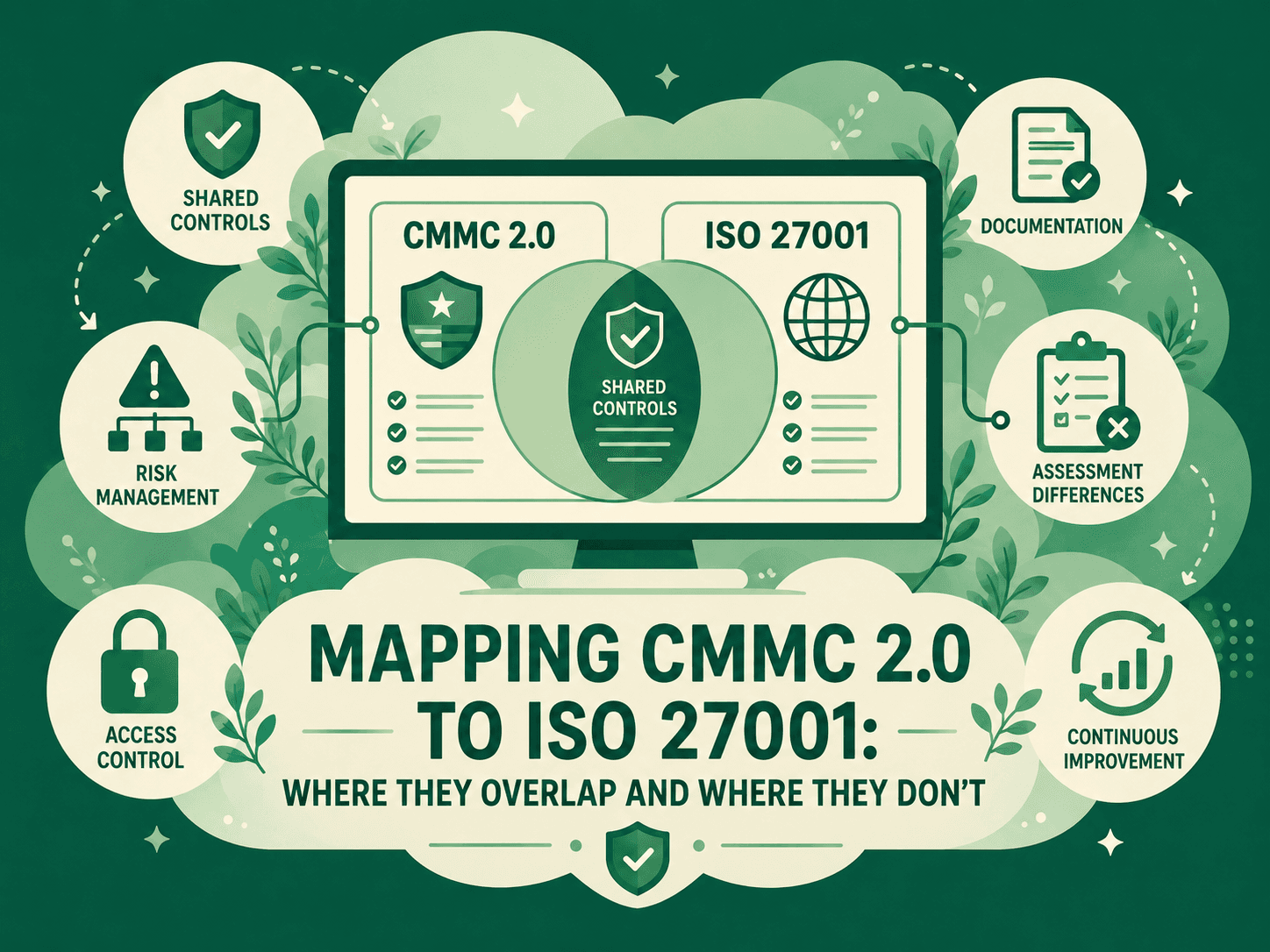
If your company sells to the US Department of Defense and operates internationally, you're probably facing two compliance requirements at once: CMMC 2.0 from the DoD and ISO 27001 from your international clients and partners.
Running two separate compliance programs is expensive. The temptation is to find the overlap, map the controls, and get credit for work you've already done.
The good news: the overlap between CMMC 2.0 and ISO 27001 is real and substantial — particularly at CMMC Level 2. Companies that sequence their programs correctly and map controls deliberately can reduce the total cost and time of dual certification by 30–40%.
The bad news: the gaps are real, too, and they're where most companies get caught off guard during audits. CMMC has requirements ISO 27001 simply does not address. ISO 27001 has flexibility CMMC explicitly prohibits.
This guide gives you a precise, domain-by-domain mapping — what overlaps, what doesn't, and what you need to build from scratch if you're pursuing both.
What Is CMMC 2.0?
CMMC (Cybersecurity Maturity Model Certification) 2.0 is the US Department of Defense's framework for ensuring that defense contractors and their supply chains adequately protect Controlled Unclassified Information (CUI) and Federal Contract Information (FCI).
Released in 2021 as a streamlined revision of CMMC 1.0, CMMC 2.0 reduced the original five levels to three:
Level 1 (Foundational): 17 practices from FAR 52.204-21. Applies to companies handling FCI only. Annual self-assessment.
Level 2 (Advanced): 110 practices aligned 1:1 with NIST SP 800-171. Applies to companies handling CUI. Requires third-party assessment (C3PAO) for most contracts.
Level 3 (Expert): 110+ practices from NIST SP 800-172. Applies to the highest-priority DoD programs. Government-led assessments.
The majority of this guide focuses on CMMC Level 2, which most defense contractors face and provides the most meaningful overlap with ISO 27001.
CMMC 2.0 became a formal requirement embedded in DoD contracts starting in 2025, making certification a hard gate for new and renewed defense contracts.
What Is ISO 27001?
ISO/IEC 27001 is the international standard for Information Security Management Systems (ISMS). Published by the International Organization for Standardization, it specifies requirements for establishing, implementing, maintaining, and continually improving an ISMS.
The 2022 revision (ISO 27001:2022) restructured Annex A from 114 controls across 14 domains to 93 controls across 4 themes: Organizational, People, Physical, and Technological.
ISO 27001 is risk-based and flexible — organizations select controls based on a risk treatment process, and the standard does not mandate specific technical configurations. Certification is granted by an accredited third-party certification body (CB) after a Stage 1 (documentation review) and Stage 2 (implementation audit).
ISO 27001 is recognized in over 150 countries and is increasingly required by European enterprise buyers, government procurement, and multinational supply chains.
The Common Root: NIST SP 800-171
Before mapping CMMC to ISO 27001, it's important to understand why meaningful overlap exists in the first place.
CMMC Level 2 is directly derived from NIST SP 800-171, which in turn draws heavily on NIST SP 800-53. ISO 27001's controls were developed through a parallel process rooted in international information security best practices — many of which reference or align with NIST.
Both frameworks ultimately address the same fundamental security problem: how to protect sensitive information from unauthorized access, disclosure, modification, and destruction. The difference is in how prescriptively they answer that question.
CMMC: "You must implement these specific 110 practices, exactly as written."
ISO 27001: "You must manage information security risk, and here are controls you should consider implementing."
This explains both the overlap (shared objectives) and the gaps (different methodologies).
CMMC 2.0 to ISO 27001 Control Mapping: Domain by Domain
CMMC Level 2 organizes its 110 practices across 14 domains. Below is a domain-level mapping to ISO 27001:2022 Annex A controls, with overlap assessment and gap notes.
1. Access Control (AC) — 22 Practices
CMMC requirements: Limit system access to authorized users, processes, and devices. Control remote access. Enforce least privilege. Separate duties.
ISO 27001 overlap: Strong overlap with Annex A controls A.5.15 (Access control), A.5.18 (Access rights), A.8.2 (Privileged access rights), A.8.3 (Information access restriction), A.8.5 (Secure authentication), A.8.18 (Use of privileged utility programs).
Gap: CMMC AC.2.006 requires controlling the use of portable storage devices on external systems — a specific technical control not explicitly required by ISO 27001's risk-based approach. If your ISO 27001 risk assessment didn't flag portable storage as a risk, you may not have a control in place.
Overlap rating: High (75–80%)
2. Awareness and Training (AT) — 3 Practices
CMMC requirements: Ensure personnel are aware of security risks. Provide security awareness training. Train roles with security responsibilities.
ISO 27001 overlap: Strong overlap with A.6.3 (Information security awareness, education, and training) and A.5.1 (Policies for information security).
Gap: CMMC AT.2.057 specifically requires training for insider threat awareness — a topic ISO 27001 does not mandate as a distinct training requirement.
Overlap rating: High (70%)
3. Audit and Accountability (AU) — 9 Practices
CMMC requirements: Create, protect, and retain audit logs. Review logs for anomalies. Ensure traceability of user actions.
ISO 27001 overlap: Moderate overlap with A.8.15 (Logging), A.8.17 (Clock synchronization), A.8.16 (Monitoring activities).
Gap: CMMC requires specific log retention periods and protection of audit logs from modification. ISO 27001 leaves retention duration to the organization's risk assessment — meaning an ISO 27001-certified company may have gaps in log retention duration or integrity controls that CMMC would flag.
Overlap rating: Moderate (55–65%)
4. Configuration Management (CM) — 9 Practices
CMMC requirements: Establish baseline configurations. Control changes to systems. Restrict unauthorized software (application whitelisting). Deny by default.
ISO 27001 overlap: Partial overlap with A.8.9 (Configuration management), A.8.19 (Installation of software on operational systems), A.8.32 (Change management).
Gap: CMMC CM.2.061 requires a deny-by-default, allow-by-exception software policy (application whitelisting). This is a specific, prescriptive technical control that ISO 27001 does not mandate — it only requires managing software installation risk. Many ISO 27001-certified organizations do not have formal application whitelisting in place.
Overlap rating: Moderate (50–60%)
5. Identification and Authentication (IA) — 11 Practices
CMMC requirements: Identify and authenticate users. Enforce multi-factor authentication (MFA) for privileged and non-local users. Manage authenticators (passwords). Employ replay-resistant authentication.
ISO 27001 overlap: Strong overlap with A.8.5 (Secure authentication), A.5.16 (Identity management), A.5.17 (Authentication information).
Gap: CMMC IA.3.083 specifically requires replay-resistant authentication mechanisms — a technical control ISO 27001 does not explicitly call out. Additionally, CMMC mandates MFA for all remote access and privileged users as a hard requirement; ISO 27001 treats MFA as a risk-based decision.
Overlap rating: High (65–75%)
6. Incident Response (IR) — 3 Practices
CMMC requirements: Establish incident response capabilities. Track, document, and report incidents. Test incident response plans.
ISO 27001 overlap: Strong overlap with A.5.24 (Information security incident management planning), A.5.25 (Assessment of information security events), A.5.26 (Response to information security incidents), A.5.27 (Learning from incidents).
Gap: CMMC IR.2.093 requires reporting incidents to appropriate DoD authorities — a government reporting obligation ISO 27001 does not address. If you're subject to CMMC, you need a specific incident-reporting workflow to the DoD, independent of your ISO incident management process.
Overlap rating: High (70–75%)
7. Maintenance (MA) — 6 Practices
CMMC requirements: Perform maintenance on systems. Control tools, techniques, and personnel for maintenance. Manage maintenance performed remotely.
ISO 27001 overlap: Partial overlap with A.5.37 (Documented operating procedures), A.8.13 (Information backup), A.7.13 (Equipment maintenance).
Gap: CMMC has significantly more prescriptive requirements for remote maintenance — specifically, it requires MFA for remote maintenance sessions and sanitizing or destroying media used for maintenance. ISO 27001's physical and environmental controls cover some of this, but not at this level of specificity.
Overlap rating: Low-Moderate (40–50%)
8. Media Protection (MP) — 9 Practices
CMMC requirements: Protect media containing CUI. Limit access. Sanitize or destroy media before disposal. Control the transport of media.
ISO 27001 overlap: Moderate overlap with A.7.10 (Storage media), A.8.10 (Information deletion), A.7.14 (Secure disposal or re-use of equipment).
Gap: CMMC MP.2.121 and MP.2.122 require formal media sanitization procedures mapped to NIST SP 800-88 standards. ISO 27001 requires media to be disposed of securely, but does not reference a specific sanitization standard. Your ISO 27001 media disposal procedure may not meet CMMC's technical standard.
Overlap rating: Moderate (50–60%)
9. Personnel Security (PS) — 2 Practices
CMMC requirements: Screen individuals before authorizing access. Ensure CUI is protected during and after personnel actions (termination, transfer).
ISO 27001 overlap: Strong overlap with A.6.1 (Screening), A.6.2 (Terms and conditions of employment), A.6.5 (Responsibilities after termination or change of employment).
Gap: Minimal. This is one of the highest-overlap domains. The main nuance is that CMMC PS requirements apply specifically to access to CUI environments, which may require scoping your ISO 27001 HR security processes to that specific boundary.
Overlap rating: Very High (85–90%)
10. Physical Protection (PE) — 6 Practices
CMMC requirements: Limit physical access to systems. Escort visitors. Audit physical access logs. Control physical access devices.
ISO 27001 overlap: Strong overlap with A.7.1 (Physical security perimeters), A.7.2 (Physical entry), A.7.3 (Securing offices, rooms, and facilities), A.7.4 (Physical security monitoring), A.7.6 (Working in secure areas).
Gap: Minimal for on-premises environments. Cloud-first companies that rely entirely on cloud service providers face a gap — CMMC still requires you to control physical access to systems processing CUI, which, for cloud environments, means ensuring your cloud provider's physical security meets CMMC requirements (typically via FedRAMP authorization).
Overlap rating: Very High (80–85%)
11. Risk Assessment (RA) — 3 Practices
CMMC requirements: Periodically assess risk. Scan for vulnerabilities. Remediate vulnerabilities in accordance with risk assessments.
ISO 27001 overlap: Strong overlap — risk assessment is the core mechanism of ISO 27001. A.8.8 (Management of technical vulnerabilities), A.5.29 (Information security during disruption), and the entire Clause 6 (Planning) are directly relevant.
Gap: CMMC RA.2.141 requires periodic vulnerability scanning, which ISO 27001 supports but doesn't mandate at a specific cadence. If your ISO 27001 risk assessment didn't conclude that automated vulnerability scanning is necessary, you may lack this control.
Overlap rating: High (70–80%)
12. Security Assessment (CA) — 4 Practices
CMMC requirements: Periodically assess security controls. Develop and implement plans of action (POA&Ms). Monitor security controls.
ISO 27001 overlap: Moderate overlap with A.5.35 (Independent review of information security), A.5.36 (Compliance with policies and standards), and Clause 9 internal audit requirements.
Gap: CMMC's POA&M (Plan of Action and Milestones) requirement is a DoD-specific artifact with a defined structure and tracking cadence. ISO 27001 requires documented nonconformities and corrective actions, but a standard ISO corrective action log is not equivalent to a CMMC-compliant POA&M. This is a documentation gap that many companies underestimate.
Overlap rating: Moderate (55–65%)
13. System and Communications Protection (SC) — 16 Practices
CMMC requirements: Monitor and control communications. Implement subnetworks for public-facing systems. Employ architectural designs that limit CUI exposure. Implement cryptographic protections.
ISO 27001 overlap: Moderate overlap with A.8.20 (Network security), A.8.21 (Security of network services), A.8.22 (Segregation of networks), A.8.24 (Use of cryptography), A.8.26 (Application security requirements).
Gap: CMMC SC.3.177 requires FIPS-validated cryptography for protecting CUI — a specific federal standard (FIPS 140-2/140-3) that ISO 27001 does not mandate. If your cryptography implementation isn't FIPS-validated, you'll need to remediate even if your ISO 27001 audit passed. This is one of the most common technical gaps discovered in dual-compliance assessments.
Overlap rating: Moderate (50–60%)
14. System and Information Integrity (SI) — 7 Practices
CMMC requirements: Identify and manage information system flaws. Protect from malicious code. Monitor systems. Implement spam protection.
ISO 27001 overlap: Moderate overlap with A.8.7 (Protection against malware), A.8.8 (Management of technical vulnerabilities), A.8.16 (Monitoring activities).
Gap: CMMC SI.2.214 requires security alerts and advisories to be received and acted upon from external sources (e.g., US-CERT). ISO 27001 supports this through threat intelligence controls (A.5.7) but does not mandate subscription to specific government advisory feeds. This is a process gap most ISO 27001 companies need to close.
Overlap rating: Moderate (55–65%)
Summary: Overlap and Gap at a Glance
CMMC Domain | Practices | ISO 27001 Overlap | Key Gap |
|---|---|---|---|
Access Control | 22 | High | Portable storage device controls |
Awareness & Training | 3 | High | Insider threat training |
Audit & Accountability | 9 | Moderate | Log retention specifics |
Configuration Management | 9 | Moderate | Application whitelisting |
Identification & Authentication | 11 | High | Replay-resistant auth, mandatory MFA |
Incident Response | 3 | High | DoD reporting obligations |
Maintenance | 6 | Low-Moderate | Remote maintenance MFA + media sanitization |
Media Protection | 9 | Moderate | NIST SP 800-88 sanitization standard |
Personnel Security | 2 | Very High | CUI-specific scoping |
Physical Protection | 6 | Very High | Cloud FedRAMP alignment |
Risk Assessment | 3 | High | Mandated vulnerability scan cadence |
Security Assessment | 4 | Moderate | POA&M structure and format |
System & Comms Protection | 16 | Moderate | FIPS-validated cryptography |
System & Info Integrity | 7 | Moderate | Government advisory subscriptions |
The 5 Gaps That Catch Companies Off Guard
Based on how dual-compliance assessments typically go, these are the five CMMC requirements that ISO 27001-certified companies most commonly fail to have in place:
1. FIPS 140-2/140-3 Validated Cryptography (SC.3.177) ISO 27001 requires "appropriate" cryptography. CMMC requires federally validated cryptography. If you're using encryption libraries that aren't on the FIPS Cryptographic Module Validation Program (CMVP) list, you have a gap — regardless of your ISO 27001 certification status.
2. Plan of Action & Milestones (POA&M) Format (CA.2.158) ISO 27001 corrective action records do not satisfy CMMC POA&M requirements. CMMC POA&Ms require specific fields: weakness description, point of contact, resources required, scheduled completion date, milestones, and status. Build a separate POA&M tracker mapped to CMMC practices.
3. Controlled Unclassified Information (CUI) Boundary Definition ISO 27001 scoping is defined by the organization. CMMC scoping is defined by where CUI flows. Many ISO 27001-certified companies have not done a formal CUI boundary analysis — mapping every system, process, and third party that touches CUI. This is a prerequisite for CMMC assessment, and its absence will delay your certification.
4. Multi-Factor Authentication as a Hard Requirement (IA.3.083, AC.2.013) ISO 27001 treats MFA as a risk-based decision. CMMC makes it mandatory for all remote access and all privileged accounts — no exceptions, no risk acceptance. If you have any remote or privileged accounts without MFA, you're non-compliant regardless of what your ISO 27001 risk treatment plan says.
5. Government Incident Reporting (IR.2.093) When a cybersecurity incident affects CUI, CMMC requires reporting to the DoD Cyber Crime Center (DC3) within 72 hours, including submission of a malware sample if applicable. Your ISO 27001 incident response procedure almost certainly doesn't include this step. It needs to.
How to Build a Dual-Compliance Program: Sequencing That Works
If you're pursuing both ISO 27001 and CMMC 2.0, here's the sequencing that minimizes rework and total cost:
Phase 1: ISO 27001 Foundation (Months 1–9)
Build your ISMS with CMMC in mind from day one. When writing your risk assessment, explicitly evaluate CMMC-relevant threats. When selecting Annex A controls, document CMMC practice alignment. When defining scope, include your CUI boundary even if ISO 27001 doesn't require it.
This phase produces your ISO 27001 certification and simultaneously closes 60–70% of your CMMC Level 2 gaps.
Phase 2: CMMC Gap Remediation (Months 10–15)
Conduct a formal CMMC gap assessment using NIST SP 800-171A as your assessment guide. Your ISO 27001 internal audit evidence will satisfy many evidence requirements. Focus remediation effort on the five high-gap areas above: FIPS cryptography, POA&M process, CUI boundary, mandatory MFA enforcement, and DoD incident reporting integration.
Phase 3: CMMC Level 2 C3PAO Assessment (Months 15–18)
Engage a CMMC Third-Party Assessment Organization (C3PAO) once your POA&Ms show all 110 practices are either fully implemented or have credible remediation plans with defined timelines. Your ISO 27001 certification gives the assessor confidence in your ISMS foundation and often reduces assessment time.
Total Estimated Cost: Dual Compliance Program
Phase | Timeline | Estimated Cost |
|---|---|---|
ISO 27001 implementation & certification | 6–9 months | $40,000–$120,000 |
CMMC gap assessment | 4–8 weeks | $15,000–$30,000 |
CMMC-specific remediation | 3–6 months | $20,000–$80,000 |
C3PAO assessment | 2–3 months | $30,000–$75,000 |
Total (dual compliance) | 15–18 months | $105,000–$305,000 |
For comparison, building CMMC Level 2 compliance from scratch without ISO 27001 foundation typically costs $150,000–$400,000 and takes 18–24 months, because you're building the ISMS infrastructure from zero.
CMMC 2.0 vs ISO 27001: Key Structural Differences
Beyond the control-level mapping, there are fundamental structural differences that affect how you approach both programs:
Dimension | CMMC 2.0 | ISO 27001 |
|---|---|---|
Governing body | US Department of Defense | ISO/IEC (international) |
Mandatory vs voluntary | Mandatory for DoD contracts | Voluntary (market-driven) |
Methodology | Prescriptive (all 110 practices required) | Risk-based (controls selected by risk) |
Scoping | Defined by CUI flow | Defined by organization |
Risk acceptance | Not permitted for Level 2 | Permitted with documented justification |
Assessment body | C3PAO (CMMC-authorized) | Accredited certification body (CB) |
Certification validity | 3 years | 3 years (with annual surveillance audits) |
Self-assessment permitted | Level 1 only; Level 2 requires C3PAO for most | Stage 1/2 audits required for certification |
International recognition | US DoD supply chain only | 150+ countries |
Continuous monitoring | CMMC affirm annually | Surveillance audits + internal audits |
Frequently Asked Questions
Does ISO 27001 certification satisfy CMMC 2.0 requirements? No. ISO 27001 certification does not satisfy CMMC 2.0 requirements and cannot substitute for a C3PAO assessment. However, it significantly reduces the gap. Companies with ISO 27001 certification typically close 60–70% of CMMC Level 2 requirements through their existing ISMS controls, reducing the cost and time of subsequent CMMC certification.
Can I use my ISO 27001 evidence for my CMMC assessment? Yes, partially. Evidence artifacts from your ISO 27001 program — access control policies, risk assessments, training records, incident response procedures, audit logs — can be reused directly in your CMMC assessment, provided they meet CMMC's specific requirements. Your C3PAO will evaluate the evidence against CMMC practice requirements, not ISO criteria.
What is the biggest difference between CMMC 2.0 and ISO 27001? The most fundamental difference is methodology. ISO 27001 is risk-based: you select controls based on your risk assessment, and you can accept residual risk with documentation. CMMC Level 2 is prescriptive: all 110 practices are required with no option for risk acceptance. A control gap is a finding, regardless of your risk treatment decision.
Does CMMC 2.0 replace NIST SP 800-171? No. CMMC 2.0 Level 2 is built on NIST SP 800-171 and requires implementation of all 110 practices from that standard. CMMC adds the third-party assessment requirement — it's the enforcement mechanism for NIST SP 800-171, not a replacement.
How long does CMMC Level 2 certification take if we already have ISO 27001? With a mature ISO 27001 program in place, most companies can achieve CMMC Level 2 certification in 9–12 additional months. Without ISO 27001, the typical timeline is 18–24 months.
What is a POA&M in CMMC, and does ISO 27001 have an equivalent? A POA&M (Plan of Action and Milestones) is a CMMC-required document that tracks identified security weaknesses, the resources and timeline to fix them, and status updates. ISO 27001 requires corrective action records for nonconformities (Clause 10.1), which serve a similar purpose but lack the specific structure and fields CMMC assessors expect. Build a separate, CMMC-formatted POA&M tracker.
The Bottom Line
The overlap between CMMC 2.0 and ISO 27001 is real — roughly 60–70% at the control level, highest in Access Control, Personnel Security, Physical Protection, and Incident Response. If you're building for both, ISO 27001 is the right foundation to establish first.
But the gaps are consequential. FIPS-validated cryptography, mandatory MFA with no risk acceptance, POA&M documentation, DoD incident reporting, and CUI boundary analysis are CMMC requirements that ISO 27001 certification will not close for you. These are not edge cases — they come up in virtually every dual-compliance gap assessment.
The companies that do this well treat ISO 27001 and CMMC as one integrated program from day one, not two sequential projects. Map your controls once, build your ISMS to satisfy both, and document the CMMC alignment explicitly in your Statement of Applicability. When your C3PAO assessment arrives, you'll spend less time building evidence and more time demonstrating the maturity you've already built.
Want to close your CMMC and ISO 27001 gaps faster with automated control mapping? See how Dsalta maps controls across frameworks in real time →
Explore more ISO 27001 articles
ISO 27001 Implementation & Certification
Stop losing deals to compliance.
Get compliant. Keep building.
Join 100s of startups who got audit-ready in days, not months.