Third Party Risk Management (TPRM) —
Risk Management Framework: Auditor-Ready KPIs & Reporting
Learn how to build an audit-ready risk management framework with metrics, KPIs, and reports aligned to SOC 2, ISO 27001, HIPAA, and GDPR for modern SaaS teams
Dogan Akbulut
Strategic Implementation
Share this article


Introduction: Why Auditors Care About Your Risk Management Framework
When auditors review your organization, they are not just looking at isolated controls. They are evaluating how those controls fit into your overall risk management framework. A well-designed framework shows that your security, compliance, and operational practices are intentional, risk-based, and sustainable—not reactive or ad hoc.
For modern SaaS, AI, and cloud teams, a strong risk management framework does more than satisfy audit requirements. It helps prioritize limited resources, align security initiatives with business goals, and communicate clearly with stakeholders inside and outside the organization. When the framework is clear, documented, and linked to measurable metrics and KPIs, auditors can quickly understand how you identify, assess, and treat risk.
This guide walks through how to build a risk management framework that auditors appreciate, using practical metrics, KPIs, and reporting templates. It connects directly with your broader compliance program, including SOC 2, ISO 27001, HIPAA, and GDPR, so you can avoid duplicating effort across multiple standards.
What Auditors Look For in a Risk Management Framework
Auditors want to see that your risk management framework is documented, consistently applied, and aligned with recognized compliance frameworks. They expect a clear methodology for identifying risks, assessing their impact and likelihood, selecting appropriate controls, and tracking remediation progress over time.
Specifically, they look for evidence that your risks are linked to your Trust Services Criteria (for SOC 2), your Annex A controls (for ISO 27001), and any legal or regulatory requirements that apply to your business. They want to understand not only what controls you have, but why you chose them and how you know they work.
A risk management framework that auditors love is one that tells a coherent story: your business context, your major risks, the controls you have implemented, the metrics you track, and the way you adapt over time. The sections below show how to structure this story and support it with meaningful KPIs and reporting.
Defining Your Risk Management Framework
A risk management framework describes how your organization identifies, evaluates, and responds to risk. It should be formal enough to guide decisions, but practical enough to operate day to day. Many teams start by aligning to well-known models such as ISO 31000 or the risk components in SOC 2 readiness guidance.
At a minimum, your framework should define your risk appetite, your risk assessment methodology, your control selection criteria, and your governance structure. It should describe how risks are documented, how often they are reviewed, and who is accountable for managing them. This is the foundation that makes your metrics and KPIs meaningful.
You can reinforce this framework by mapping it explicitly to your compliance objectives—linking key risks to SOC 2 control areas, ISO 27001 requirements, and your privacy and sector-specific standards. This gives auditors a familiar anchor point and reduces repetitive explanations during fieldwork.
Core Components Auditors Expect to See
Risk Register
The risk register is the central artifact of your framework. It lists your key risks, their impact and likelihood, the controls that address them, and their current status. Auditors use it to understand your risk profile and how you prioritize mitigation efforts.
A well-maintained risk register includes clear risk descriptions, assigned owners, target treatment dates, and references to related controls or initiatives. It should be updated regularly and reviewed in governance meetings, not just before an audit. Many organizations use their risk register as a bridge between SOC 2 control examples and their operational reality.
Risk Assessment Methodology
Your risk assessment methodology explains how you evaluate risks and decide which ones matter most. Auditors want to see that you apply this method consistently, not that you choose ratings arbitrarily.
This typically includes a scoring model for impact and likelihood, criteria for different risk levels, and a process for reviewing and validating assessments. Documenting this methodology and referring to it in your risk register gives auditors confidence that your risk ratings are meaningful and repeatable.
Governance and Ownership
Effective risk management depends on clear governance. Auditors look for defined roles and responsibilities, regular risk review meetings, and leadership engagement. They want to know who ultimately owns risk decisions and who is responsible for executing mitigation actions.
This governance structure should align with your broader compliance and security leadership model—for example, the same stakeholders involved in SOC 2 best practices reviews or internal audit activities. When auditors see consistency across these processes, they are more confident in your overall control environment.
Designing Metrics and KPIs That Matter
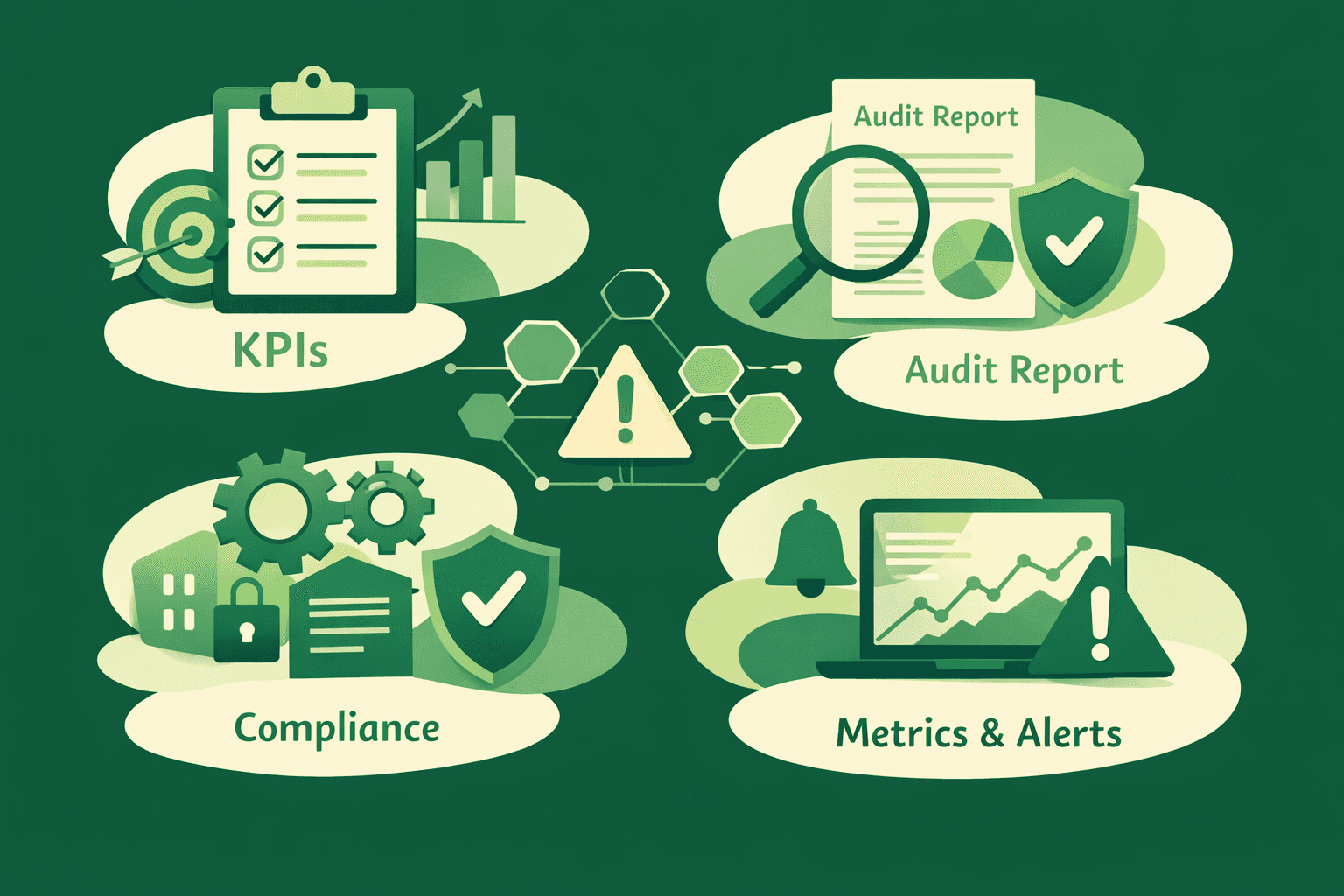
Metrics and KPIs translate your risk management framework into measurable signals. They show auditors—and your own leadership—how well your controls are working and where attention is needed. The best metrics are aligned to your highest risks and your strategic objectives, not just easy-to-count numbers.
When choosing KPIs, focus on measures that are actionable, repeatable, and clearly defined. Each KPI should have an owner, a target or threshold, and a documented calculation method. This structure not only supports audits but also enables effective reporting to boards, executives, and operational teams.
Risk Exposure Metrics
Risk exposure metrics show how much risk remains in your environment after controls are applied. Examples include counts of high or critical risks, trend lines for risk reduction over time, and the distribution of risks by category (such as security, privacy, operational, or third-party).
These metrics help auditors understand whether your risk posture is improving, stable, or deteriorating. They also provide a quick way to verify that your mitigation efforts are focused on the right areas, such as the control domains highlighted in strategic risk management guidance.
Control Effectiveness Metrics
Control effectiveness metrics show whether your controls are operating as intended. Examples include completion rates for access reviews, percentages of systems covered by logging, or the number of successful vs. blocked security events in a given period.
These metrics connect directly to your audit scope. If your metrics indicate gaps—for example, incomplete coverage of critical systems—auditors may ask about compensating controls or remediation plans. Tracking these indicators over time shows that you are monitoring control health proactively, not only at audit time.
Remediation and Exception Metrics
Remediation metrics track how quickly and effectively you address identified issues, such as audit findings, vulnerability scan results, or internal control exceptions. Common KPIs include time to remediate high-risk findings, percentage of overdue actions, and closure rates per reporting period.
Exception metrics capture formally accepted deviations from standard controls, such as temporary risk acceptances or compensating controls. Documenting these exceptions and tracking their status demonstrates discipline and transparency—attributes auditors value highly.
Reporting Templates Auditors Appreciate
Reporting templates turn your framework and metrics into digestible information for different audiences. Auditors appreciate reports that are structured, consistent, and clearly linked to your risk register and control environment.
A typical reporting set might include an executive summary highlighting top risks and trends, detailed risk register exports, control performance dashboards, and status reports on remediation initiatives. When these artifacts are well-designed, they reduce back-and-forth during audits and make it easier to answer detailed questions.
Executive Risk Dashboard
An executive dashboard provides a high-level view of your risk posture. It should highlight key indicators—such as the number of open high-risk items, major risk themes, and recent changes—using visuals that non-technical stakeholders can understand.
This dashboard can be reused in board and leadership meetings, showing that risk and compliance are part of ongoing governance, not isolated audit events. Auditors see this as a positive signal that risk management is embedded in your culture.
Audit-Ready Risk and Control Reports
Audit-ready reports present your risk and control information in formats that map directly to your audit scope. These might include exports of risk registers filtered by relevant control domains, lists of completed and pending remediation actions, and control performance summaries over the audit period.
Preparing these templates ahead of time and keeping them updated regularly reduces the scramble when auditors send their document requests. It also helps internal teams stay aligned on what “good” looks like for evidence and reporting quality.
Connecting Your Risk Framework to Compliance Outcomes
A strong risk management framework is most valuable when it is tightly connected to your compliance objectives. For example, you can map each major risk to specific SOC 2 criteria, ISO 27001 controls, or regulatory obligations, and then track progress against those mappings over time.
This connection not only streamlines audits, but also supports multi-framework strategies such as unifying SOC 2, ISO 27001, and HIPAA or multi-framework compliance in 2025. When auditors can see that your risk framework underpins all of these efforts, they gain confidence in the durability of your program.
Over time, organizations often move from manually maintained sheets and slide decks to more automated approaches, integrating risk registers, metrics, and evidence collection with their broader audit readiness and resilience strategies. This evolution makes your risk management framework not just auditor-friendly, but also a practical tool for steering your security and compliance roadmap.

Explore more TPRM articles
Stop losing deals to compliance.
Get compliant. Keep building.
Join 100s of startups who got audit-ready in days, not months.