TPRM: Your Complete Vendor Risk Guide
Written by
Published on
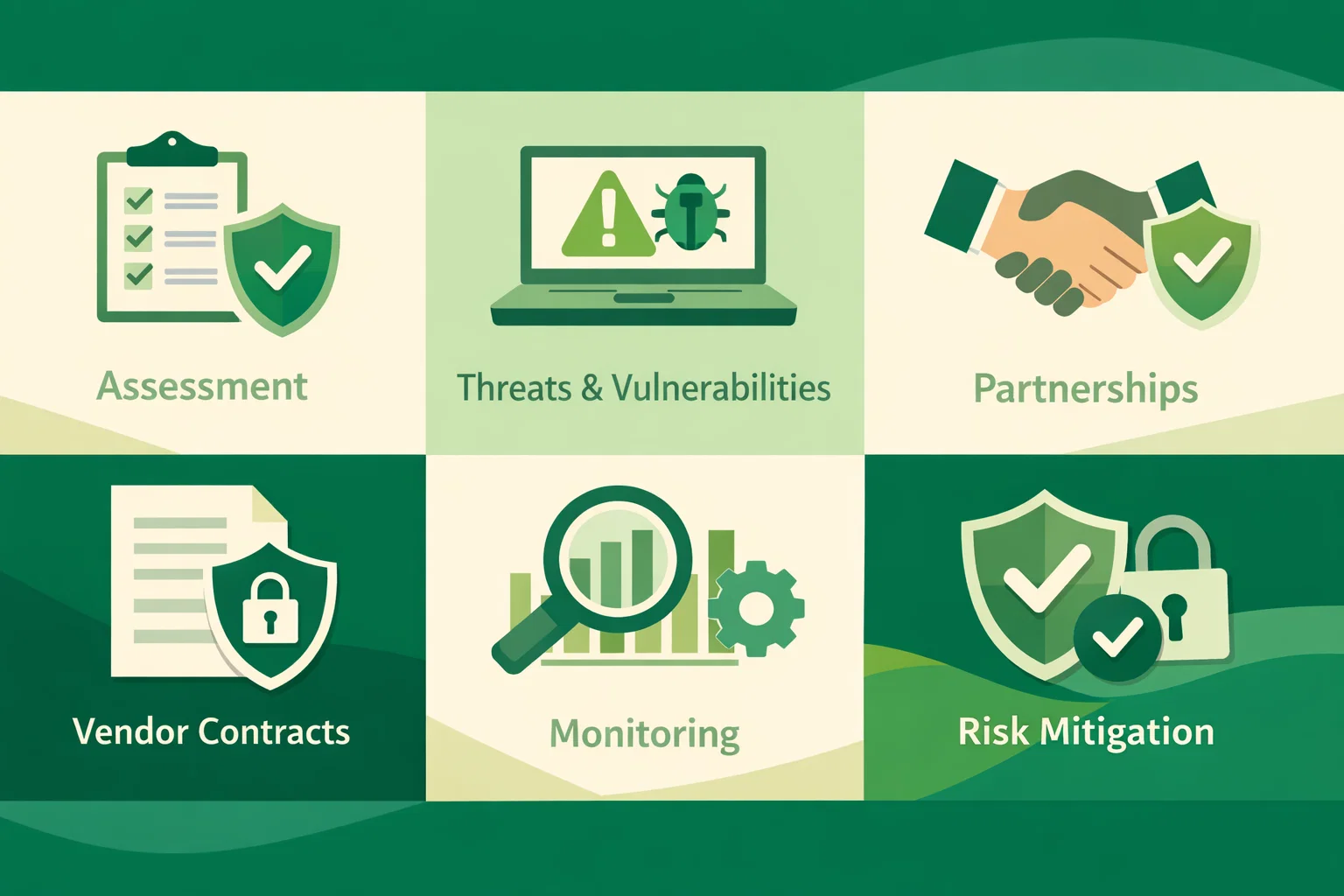
How to Build a Simple, Defensible Vendor Risk Management Process
If you're managing compliance for a growing company, vendor risk management (VRM) can feel overwhelming. But the goal isn't perfection—it's creating a defensible third-party risk management program that you can explain to customers, auditors, and your team.
NIST frames this as supply chain cybersecurity risk management: identify, assess, and mitigate risks from external products and services, integrating it into your broader risk management framework. This guide shows you how to build a practical VRM program that scales.
Part 1: Foundation of Your Vendor Risk Assessment Program
1) Start with a Vendor Inventory That Drives Action
Effective vendor risk management begins with knowing what you have. Skip the logo collection—build an actionable vendor intake system.
For each vendor, capture:
Service provided (cloud hosting, analytics, payroll, customer support)
Data accessed (customer PII, credentials, payment data, cardholder data environment (CDE), protected health information (PHI))
Criticality (production-critical vs. operational support)
Internal owner (named relationship manager)
This aligns with AICPA recommendations for vendor management programs: governance, policy, and systematic assessment. Without this foundation, your vendor risk assessment becomes guesswork.
Why this matters for compliance: If you can't identify which vendors touch sensitive data or impact production, you can't demonstrate SOC 2 compliance, ISO 27001 controls, or GDPR data processor management.
2) Classify Vendors into Risk Tiers (Keep It Simple)
Vendor risk scoring starts with tiering. This is how you avoid wasting resources on low-risk vendors while ensuring vendor due diligence for critical partners.
Simple 3-tier model:
Tier 1 (Critical Third-Party Risk):
Touches sensitive data or impacts production security/availability
Examples: cloud hosting, IAM providers, payment processors, PCI DSS payment pages, HIPAA business associates
Requires: SOC 2 Type II, ISO 27001 certification, or equivalent vendor attestations
Tier 2 (Moderate Supplier Risk):
Some sensitive access or operational impact
Examples: customer support platforms, marketing automation with PII
Requires: Security questionnaire + control evidence
Tier 3 (Low Third-Party Risk):
No sensitive data, minimal impact
Examples: design tools, scheduling software
Requires: Basic security review
NIST CSF 2.0 explicitly calls for establishing supply-chain risk programs with stakeholders and ongoing management. Tiering makes this risk-based compliance approach practical.
3) Define "Good Enough Due Diligence" Per Tier
The biggest mistake in vendor risk management: sending 200-question due diligence questionnaires to everyone.
Set tier-appropriate minimums:
Tier 1 Requirements:
SOC 2 Type II report or ISO 27001:2022 certification
Security overview and incident response plan
MFA (multi-factor authentication) and access management controls
Data encryption (transit and at rest) verification
Subprocessor disclosure and contract risk review
For payment vendors: PCI DSS compliance status
For healthcare: BAA (business associate agreement) and HIPAA Security Rule compliance
Tier 2 Requirements:
Streamlined security questionnaire with control evidence
Data processing agreement or privacy statements
Data retention and deletion policies
Tier 3 Requirements:
Lightweight check: privacy policy, basic security posture confirmation
No sensitive data validation
SOC 2 readiness programs emphasize controls that are suitable and can be evidenced—not perfect paperwork. The Trust Services Criteria (TSC) focus on evaluating control design and operating effectiveness.
4) Ask Questions That Expose Risk Quickly
For efficient vendor risk assessment, especially Tier 1 vendor due diligence, focus on these critical questions:
Essential Due Diligence Questions:
What data do you store/process for us? (data minimization check)
Do you support SSO (single sign-on) and MFA requirements for all users?
How do you manage privileged access and enforce least privilege?
Do you encrypt data in transit and at rest? (data encryption standards)
What's your incident response process and breach notification timeline?
Do you have SOC 2 Type II / ISO 27001 certification? If not, what's your SOC 2 readiness assessment timeline?
Do you use subprocessors? Can you share the list and SCCs (Standard Contractual Clauses) for cross-border data transfers?
How do you handle vulnerability management, patch management, and pen testing?
Where is data hosted (data localization requirements) and how is it segregated?
What evidence can you provide now? (SOC 2 audit report, control activities, trust center, evidence collection)
These align with AICPA guidance on third-party risk management: governance, assessment, due diligence, and evaluation of vendor risk controls.
Bonus for regulated industries:
PCI DSS vendors: Ask about PCI SAQ (self-assessment questionnaire) completion and merchant due diligence
HIPAA vendors: Verify the implementation of administrative safeguards and technical safeguards implementation
GDPR compliance: Confirm data subject rights support and DPIA (data protection impact assessment) completion
5) Score Risk with a Practical Model
Build a simple vendor risk scoring framework:
Two-axis scoring:
Impact (1-5): How severe is it if this vendor fails?
Likelihood (1-5): How likely is it based on maturity and control evidence?
Risk Score = Impact × Likelihood
Required actions:
High risk → Remediation plan required before production use
Medium risk → Accept with compensating controls or contract risk mitigations
Low risk → Accept with standard monitoring
This fits NIST's risk assessment approach: assess, then apply mitigations across the supply chain based on risk appetite.
Integration with frameworks:
Map to SOC 2 control activities (CC2.1 for vendor oversight)
Align with ISO 27001 controls (A.15 for supplier relationships)
Support SOC 2 reporting and audit readiness
6) Document Decisions for Audit Readiness
Audit readiness requires evidence trails. Teams fail silently here.
For each Tier 1 vendor, maintain:
What you reviewed (SOC 2 Type II report, questionnaire, vendor attestations)
Gap assessment findings (gaps and strengths)
Decision rationale (approve / conditional approval/reject)
Remediation tracking with owners and dates
Control mapping to your ISMS (information security management system)
This transforms ad-hoc reviews into a continuous compliance program that satisfies SOC 2 audits, ISO 27001 internal audits, and regulatory audits.
Part 2: Continuous Vendor Risk Management and Monitoring
Most teams treat vendor risk management as a one-time gate. The real value comes from continuous monitoring—because vendors change, products evolve, and your stack expands.
NIST guidance emphasizes integrating supply-chain risk into ongoing compliance management, not one-off checklists.
1) Embed Security Requirements in Contracts
If it's not in the contract, it's wishful thinking.
Essential contract clauses for Tier 1 vendors:
Breach notification timelines (24-72 hours)
Security control commitments (MFA, data encryption, access management for vendors)
Right to audit or receive assurance reports (annual SOC 2 Type II)
Subprocessor disclosure and change notification
Data retention and deletion terms (GDPR compliance)
Business continuity and disaster recovery commitments
For GDPR: Data processing agreement with SCCs for cross-border data transfers
For HIPAA: BAA with specified PHI safeguards
For PCI: PCI compliance maintenance and vulnerability scanning requirements
ISO 27001 supplier controls emphasize setting security expectations in agreements and managing supplier security over time—consistent with NIST CSF supply-chain governance.
2) Replace Annual Panic with Continuous Monitoring
Continuous monitoring doesn't require enterprise platforms on day one. Start with cadence and triggers.
Review cadence by tier:
Tier 1: Quarterly or semi-annual review
Tier 2: Annual review
Tier 3: Review at renewal or scope changes
Immediate review triggers:
Vendor adds subprocessors (third-party risk expansion)
Product scope changes (now touches PII or production)
Security incident or major outage
Significant contract changes
Deeper integration (SSO, production access)
SOC 2 audit findings or remediation plan updates
AICPA vendor management guidance includes ongoing monitoring as a core component of the program, supporting SOC 2 readiness and continuous compliance.
3) Build an Executive VRM Dashboard
Executives need visibility into risk posture, not spreadsheet chaos.
Practical vendor risk dashboard components:
Vendor risk scoring summary: # of Tier 1 vendors, approval status
High-risk vendors with open remediation tracking
Upcoming renewals for critical suppliers
Evidence freshness (last review date, expiring SOC 2 reports)
Recent incidents or outages (90-day view)
Compliance certifications status (SOC 2, ISO 27001, PCI DSS)
Gap assessment summary by vendor tier
NIST CSF 2.0 "Govern" function emphasizes oversight and integrating cyber risk into enterprise risk management (ERM). Your vendor risk dashboard operationalizes this principle.
4) Make Vendor Risk Ownership Explicit
Ambiguity kills VRM programs.
Clear ownership model:
Security/Compliance: Owns compliance program policy and minimum control objectives
Vendor owner (business lead): Manages relationship and remediation tracking
IT/Engineering: Validates technical claims and control testing
Legal/Procurement: Ensures contract risk alignment with risk appetite
This maps to the AICPA's governance-centered view of vendor management programs and supports SOC 2 control activities for vendor oversight.
5) Where AI and Automation Help (and Where They Don't)
Compliance automation can accelerate vendor risk management, but it won't replace judgment.
Effective AI use cases for VRM:
Summarize SOC 2 Type II reports and extract relevant control evidence
Control mapping vendor evidence to your TSC or ISO 27001 controls
Flag missing evidence collection in due diligence questionnaires
Track remediation plan follow-ups and renewal timelines
Generate risk assessment summaries for audit readiness
Ineffective AI approaches:
Auto-approving vendors without control evidence
Replacing auditor judgment on control design effectiveness
Generic templates that ignore your risk-based compliance needs
A Practical Starter Plan for Small Teams
4-week rollout for vendor risk management:
Week 1-2: Build vendor inventory, apply tiering, assign ownership Week 3: Create Tier 1 due diligence questionnaire and vendor risk scoring rubric Week 4: Draft contract minimums and continuous monitoring triggers. Month 2: Launch vendor risk dashboard and integrate remediation tracking
This foundation enables SOC 2 compliance, ISO 27001 certification, GDPR processor management, and regulatory compliance—without making vendor risk management a full-time burden.
Key Takeaways for Your VRM Program
Effective vendor risk management requires:
Structured vendor intake and risk-based tiering
Tier-appropriate due diligence (not one-size-fits-all questionnaires)
Evidence-based vendor risk assessment aligned with frameworks (SOC 2, ISO 27001, NIST CSF)
Contractual commitments for security controls and breach notification
Continuous monitoring with cadence and triggers, not annual scrambles
Executive visibility through a focused vendor risk dashboard
Clear ownership across Security, Business, IT, and Legal
Audit readiness through documented gap assessments and remediation plans
Third-party risk management isn't about achieving perfection—it's about building a defensible, scalable VRM program that demonstrates control objectives, supports compliance certifications, and protects your organization from supplier risk.
Need help building your vendor risk management program? DSALTA's AI-powered compliance platform automates vendor risk scoring, evidence collection, control mapping, and continuous monitoring—helping you achieve SOC 2 readiness, ISO 27001 certification, and regulatory compliance faster.
Explore more TPRM articles
Getting Started with TPRM
Vendor Assessment & Due Diligence
Automation & Tools
Strategic Implementation
Industry Reports & Benchmarks
Stop losing deals to compliance.
Get compliant. Keep building.
Join 100s of startups who got audit-ready in days, not months.