Third Party Risk Management (TPRM) —
Best VRM Practices for Cloud Providers: Quick Vendor Selection Guide
Learn proven vendor risk management practices for cloud providers. From SOC 2 compliance to continuous monitoring, build a VRM program that scales with your business.
Dogan Akbulut
Strategic Implementation
Share this article


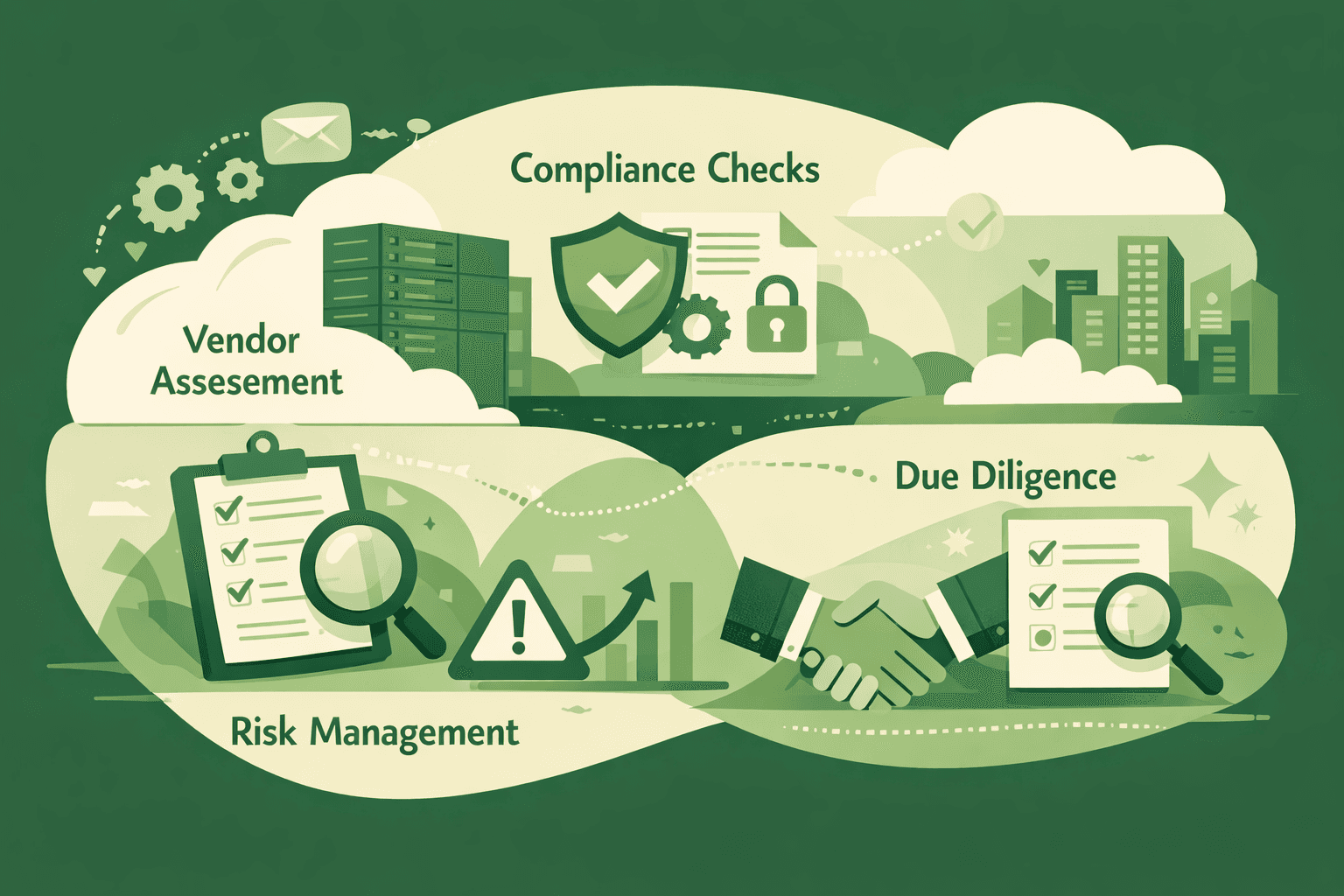
Cloud Vendor Risk Management Best Practices | VRM for SaaS & Cloud Providers
When people talk about vendor risk management for cloud providers, they're really asking one fundamental question:
How do we trust AWS, Azure, Google Cloud, or a SaaS vendor with our data and operations without getting surprised later?
The trap many organizations fall into is treating cloud VRM like a one-time questionnaire exercise. The better approach combines risk-based compliance, clarity on shared responsibility, and reusable evidence that supports both regulatory compliance and customer trust.
Whether you're building your first VRM program or strengthening an existing one, this guide covers practical vendor risk management practices that work for both startups racing toward their first SOC 2 audit and established teams managing complex third-party risk across multiple cloud environments.
Part 1: How to Pick Cloud Vendors (Without Getting Stuck in Analysis Paralysis)
1. Start with the Shared Responsibility Model (Or You'll Assess the Wrong Things)
Cloud risk operates differently from traditional vendor risk. The responsibility is split between you and the provider, and what you need to verify depends entirely on your service model—SaaS, PaaS, or IaaS.
With cloud services, the provider secures parts of the infrastructure stack while you retain ownership of securing your configurations, identities, data, and access controls. This shared responsibility boundary is critical for practical vendor risk assessment.
Practical output to document:
Service model (SaaS/PaaS/IaaS) and deployment type
Data types stored or processed (PII, PHI, cardholder data, intellectual property)
Control boundaries: Who controls identity and access management, encryption keys, audit logging, and backup procedures
Availability dependency: What operational capabilities would break if this vendor experienced downtime
This clarity prevents wasted effort on vendor due diligence activities that assess controls the provider doesn't actually own or that fall within your responsibility zone.
2. Build a "Minimum Viable Vendor Inventory."
Before conducting any formal assessments, create a simple vendor inventory that lists all cloud providers and critical SaaS vendors, tagged by:
Criticality level: Can operations continue without this vendor?
Data sensitivity: What's the classification of data this vendor accesses?
Access level: Does the vendor touch production data or hold administrative access?
Concentration risk: Are multiple critical functions dependent on a single vendor?
This inventory forms the foundation of your third-party risk management program and helps you prioritize vendor intake efforts based on actual risk rather than vendor size or sales pressure.
This approach aligns with modern supply chain risk thinking: identify and assess vendors and dependencies across your entire ecosystem, not just evaluate suppliers in isolation.
3. Use a Cloud-Native Control Framework (Don't Reinvent the Questionnaire)
For cloud providers specifically, the Cloud Security Alliance Cloud Controls Matrix (CCM) provides one of the cleanest structures for vendor assessments. The accompanying Consensus Assessments Initiative Questionnaire (CAIQ) provides a standardized format for evaluating cloud vendors without creating custom questionnaires for each evaluation.
How to use it practically:
Don't attempt to assess all 197 controls—this creates vendor due diligence bottlenecks
Select a control subset tied to your highest risks: identity and access management, encryption, audit logging, incident response, business continuity and disaster recovery, and subcontractor management.
Map these controls to your internal control objectives and compliance controls.
This targeted approach accelerates vendor onboarding while maintaining rigor where it matters most for your risk appetite.
4. Ask for Evidence That Actually Matters (SOC 2, ISO 27001, STAR, Plus Specifics)
For cloud and SaaS vendors, SOC 2 Type II reports have become a common baseline because they provide independent assurance over controls relevant to the Trust Services Criteria: security, availability, processing integrity, confidentiality, and privacy.
Request these artifacts during vendor intake:
Most recent SOC 2 Type II report examining operating effectiveness over time
ISO 27001 certification demonstrating an information security management system (ISMS)
CSA STAR attestation or CCM alignment (if available)
Security whitepaper detailing architecture and control activities
Incident response procedures and notification timelines
Subprocessor list identifying who else handles your data
Remember: you typically cannot test underlying cloud infrastructure yourself, so third-party risk assessments through independent audits and certifications carry more weight in cloud vendor evaluation than traditional vendor risk scoring approaches.
5. Define "Pass" Criteria Upfront (So You Don't Get Stuck in Endless Review)
Create simple gating rules based on vendor risk assessment outcomes:
Critical vendor + sensitive data:
Must provide SOC 2 Type II (or equivalent compliance certifications)
Clear incident response and breach notification procedures
Documented encryption posture for data at rest and in transit
Strong access management controls and MFA requirements
Non-critical + low sensitivity:
Lighter review focused on contractual protections
Basic security questionnaire
Standard data processing agreement
These criteria prevent the standard failure mode where teams waste weeks debating vendors that never had a realistic chance of meeting minimum compliance controls requirements.
Part 2: How to Monitor, Contract, and Report (Like You're Enterprise-Ready)
Once you've selected a cloud provider, the bigger risk becomes complacency. Vendors evolve, controls drift, subprocessors expand, and your usage patterns change. Effective continuous monitoring separates mature VRM programs from checkbox exercises.
6. Put VRM Requirements into Contracts (This Is Where You Win)
A firm cloud vendor contract should explicitly cover:
Security obligations and audit rights (or acceptable alternatives like SOC 2 reports)
Incident notification timelines aligned with your breach notification obligations
Subprocessor transparency with advance notice of changes
Data ownership, return procedures, and secure data retention and deletion
Uptime commitments and business continuity expectations
Termination support and exit assistance to avoid vendor lock-in
Cloud vendor risk management commonly fails due to missing exit strategies and inadequate concentration risk planning. Build these protections into contracts before you need them.
7. Move from Annual Evidence to Continuous Signals
SOC 2 Type II reports assess operating effectiveness over a historical period (typically 6-12 months), and your customers expect you to maintain control of evidence of ongoing vendor monitoring, too.
For cloud providers, continuous monitoring should include:
Vendor status pages and incident feeds
Security advisory tracking and patch management alerts
Subprocessor change notifications
Configuration drift detection on your side (where many breaches actually occur)
Regular access reviews and encryption key rotation validation
This approach supports both continuous compliance and audit readiness by demonstrating that vendor risk doesn't go unmonitored between annual reviews.
8. Maintain a Single "Evidence Spine" You Can Reuse
Most teams waste time during SOC 2 audits and customer security reviews because evidence collection is scattered across email, screenshots, spreadsheets, and Slack threads.
Instead, maintain a centralized evidence repository with reusable artifacts:
Vendor risk assessment summary (per critical vendor)
Vendor attestations (SOC 2 reports, ISO certifications, PCI DSS compliance)
Contract highlights and security addendum key terms
Monitoring log documenting what you check, frequency, and remediation tracking
This isn't just operational efficiency it reduces sales friction because your team can answer due diligence questionnaires and security reviews faster, supporting your own SOC 2 readiness.
9. Build an Executive VRM Dashboard (Simple, Not Fancy)
Executives don't need control mapping details or NIST CSF subcategories. They need clarity on risk and decision-ready information.
An effective vendor risk dashboard shows:
Top critical vendors ranked by impact and data sensitivity
Current vendor risk scoring with trend direction
Open issues categorized by severity with remediation plan status
Upcoming contract renewals and renegotiation opportunities
Concentration risk indicators highlighting single points of failure
Recent incidents and SLA breach tracking
This dashboard supports risk-based compliance decision-making and demonstrates compliance management maturity to auditors and customers.
10. Where AI Actually Helps (When Grounded in Evidence)
AI becomes useful in vendor risk management when it reduces manual work without inventing rules or hallucinating requirements. Practical applications include:
Summarizing SOC 2 reports to highlight what changed since the previous period
Extracting key contract clauses and flagging missing compliance controls
Mapping vendor evidence to your control objectives and SOC 2 control activities
Drafting customer security responses based on your approved policy management artifacts
That's the difference between "AI as a chatbot" and "AI as a workflow assistant grounded in your compliance program."
Bringing It Together: Building a VRM Program That Scales
Effective vendor risk management for cloud providers isn't about perfect questionnaires or exhaustive control testing—it's about building a risk management framework that provides clarity, supports audit readiness, and scales as your vendor ecosystem grows.
The VRM Maturity Path
Foundation Stage:
Complete vendor intake inventory with criticality ratings
Define risk appetite and gating criteria
Collect baseline vendor attestations (SOC 2, ISO 27001)
Document shared responsibility boundaries
Operational Stage:
Implement continuous monitoring for critical vendors
Establish a contract risk review process
Create a reusable evidence repository
Build an executive vendor risk dashboard
Optimization Stage:
Automate vendor risk scoring and trend analysis
Integrate VRM into a broader cybersecurity framework
Leverage AI for evidence collection and response generation
Demonstrate continuous compliance with customers and auditors
Why This Matters for Your SOC 2 Journey
If you're pursuing SOC 2 compliance, vendor risk management directly impacts multiple Trust Services Criteria:
Security (CC): Common Criteria 9 specifically addresses third-party risk and vendor management
Availability: Assessing vendor uptime and business continuity capabilities
Confidentiality: Reviewing vendor encryption and access management controls
Privacy: Evaluating data processing agreements and data subject rights handling
Your SOC 2 readiness assessment will examine how you identify, assess, and monitor vendors who could impact these criteria. Strong VRM practices provide control evidence that satisfies auditor inquiries during your SOC 2 audit.
How DSALTA Supports Cloud VRM
DSALTA's compliance platform helps organizations implement these vendor risk management best practices without building everything from scratch:
Vendor inventory with automated criticality scoring
Pre-built due diligence questionnaires aligned with SOC 2 control activities, ISO 27001 controls, and cloud security frameworks.
Centralized evidence repository connecting vendor attestations to your control objectives
Continuous monitoring workflows that track vendor changes and trigger remediation plans
Audit readiness tools that surface vendor evidence during SOC 2 reporting and customer security reviews
Whether you're preparing for your first SOC 2 audit or managing vendor risk across a complex cloud environment, DSALTA provides the structure and automation to implement these practices efficiently.
Key Takeaways
Understand shared responsibility before assessing cloud vendors; you can't evaluate what you don't control.
Prioritize by risk, not by vendor size focus vendor due diligence where data sensitivity and criticality intersect
Use cloud-native frameworks like CCM instead of creating custom questionnaires for every vendor.
Define pass criteria upfront to avoid analysis paralysis during vendor intake.
Build contract protections around incident notification, subprocessors, and exit support.
Implement continuous monitoring, annual reviews miss too much in fast-changing cloud environments.
Maintain reusable evidence that serves both regulatory compliance and customer trust-building
Create executive visibility with simple dashboards that show vendor risk and concentration.
Ground AI in evidence, use it to summarize and map, not to hallucinate requirements.
Align VRM with your compliance program; it's not a separate initiative but core to SOC 2 readiness and continuous compliance.
Effective vendor risk management for cloud providers combines practical risk assessment, explicit contractual protections, and ongoing monitoring. It's not about achieving perfection before going to production; it's about building the proper foundation and improving systematically as your cloud footprint grows.
When done well, VRM becomes an enabler rather than a blocker: it helps you move faster with cloud adoption while building the trust that enterprise customers expect, and auditors need to see.

Explore more TPRM articles
Stop losing deals to compliance.
Get compliant. Keep building.
Join 100s of startups who got audit-ready in days, not months.