ISO 27001 —
ISO 27001 Implementation Guide: Step-by-Step Certification
Complete ISO 27001 implementation guide for 2026 with a step-by-step roadmap from gap analysis to certification, including controls, docs, audits, and best practices.
John Ozdemir
ISO 27001 Implementation & Certification
Share this article


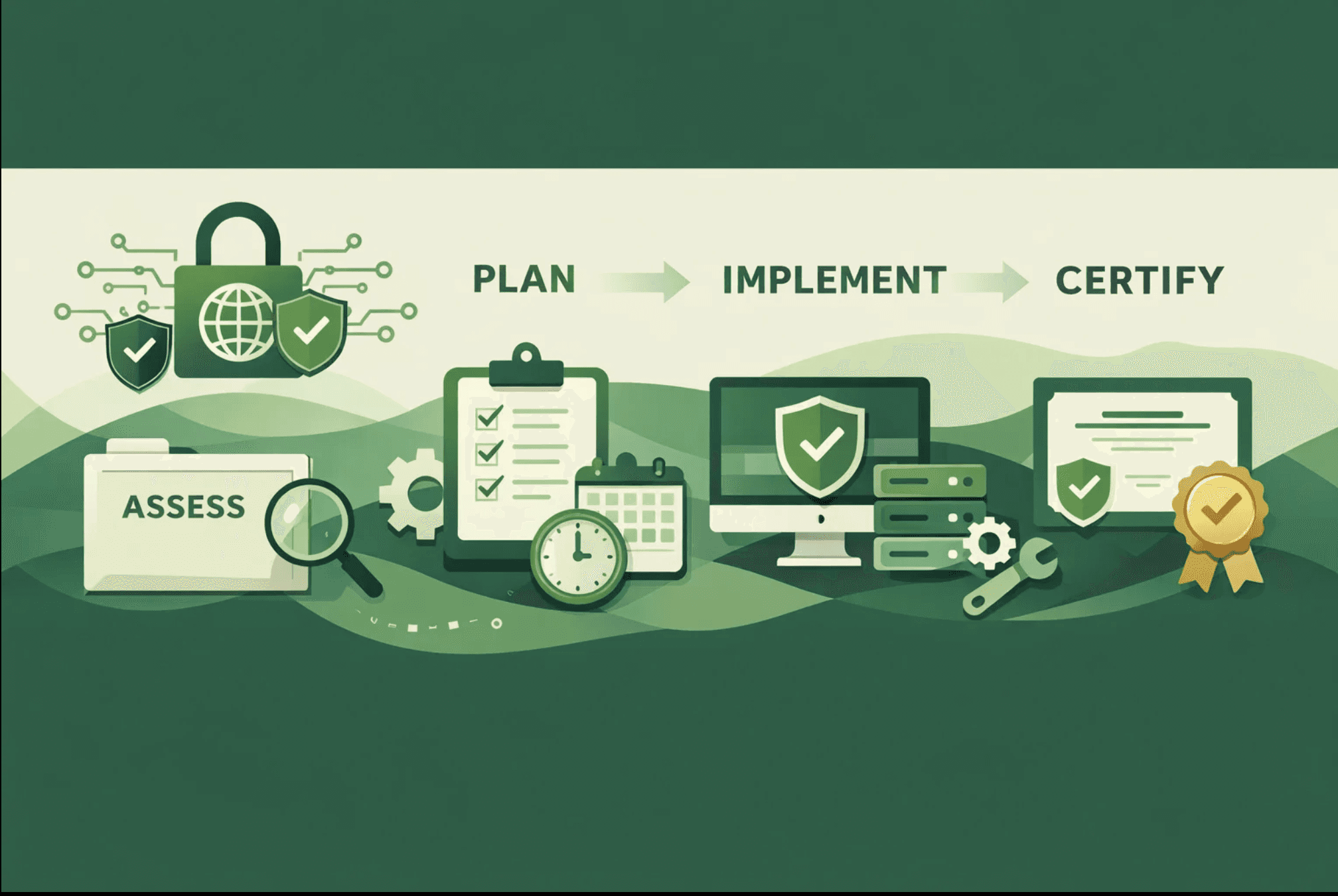
Enterprise customers are asking more challenging questions about your security practices. International partners want proof of systematic information protection. Competitors are winning deals because they have ISO 27001 certification—and you don't.
ISO 27001 implementation represents more than checking compliance boxes. It's about building a formal Information Security Management System that protects your most valuable assets while demonstrating to customers that you take security seriously.
The challenge? Many organizations don't know where to start. ISO 27001 includes 93 controls across multiple categories, requires extensive documentation, and demands systematic processes that most companies haven't formalized. Without a clear roadmap, implementation can feel overwhelming and take much longer than necessary.
This guide provides a practical, step-by-step approach to implementing ISO 27001. Whether you're a security leader planning your first certification or a compliance manager optimizing an existing program, you'll learn precisely what to do, in what order, and how to avoid common pitfalls that delay certification.
Understanding ISO 27001 Implementation Basics
What ISO 27001 Implementation Actually Involves
ISO 27001 implementation means building an Information Security Management System (ISMS) that meets the standard's requirements. This includes establishing documented policies, conducting risk assessments, implementing security controls, collecting evidence, and Continuously Improving Your Security Posture.
The implementation creates a systematic approach to managing sensitive information. Instead of ad hoc security practices, you develop repeatable processes that identify risks, protect information assets, detect incidents, and respond effectively when issues occur.
The Three Phases of Implementation
Foundation phase establishes your ISMS structure including scope definition, governance documentation, leadership commitment, and initial policy framework. This phase typically takes one to two months.
The control implementation phase addresses the security controls selected based on your risk assessment. You'll implement technical safeguards, document procedures, train employees, and begin collecting evidence. This phase usually takes 4 to 6 months.
The certification preparation phase involves internal audits, management reviews, gap remediation, and final documentation preparation before your certification audit. Plan two to three months for this phase.
Most organizations complete ISO 27001 implementation in nine to twelve months from start to certification. Companies with existing security programs or SOC 2 compliance can often significantly accelerate this timeline.
Who Should Be Involved in Implementation
Executive leadership provides approval, allocates resources, and participates in management reviews. Without visible leadership support, implementation struggles.
Security and IT teams handle the implementation of technical controls, system configuration, and ongoing security operations. They become the day-to-day operators of your ISMS.
Compliance or risk management coordinates implementation activities, manages documentation, tracks progress, and prepares for audits. This role often serves as the project manager.
Department representatives from legal, HR, facilities, and operations contribute to policies, implement controls in their areas, and ensure organization-wide adoption.
External consultants or auditors may provide expertise, gap assessments, internal audits, and certification audits, depending on your internal capabilities.
Phase 1: Gap Analysis and Planning
Conducting Your Initial Gap Assessment
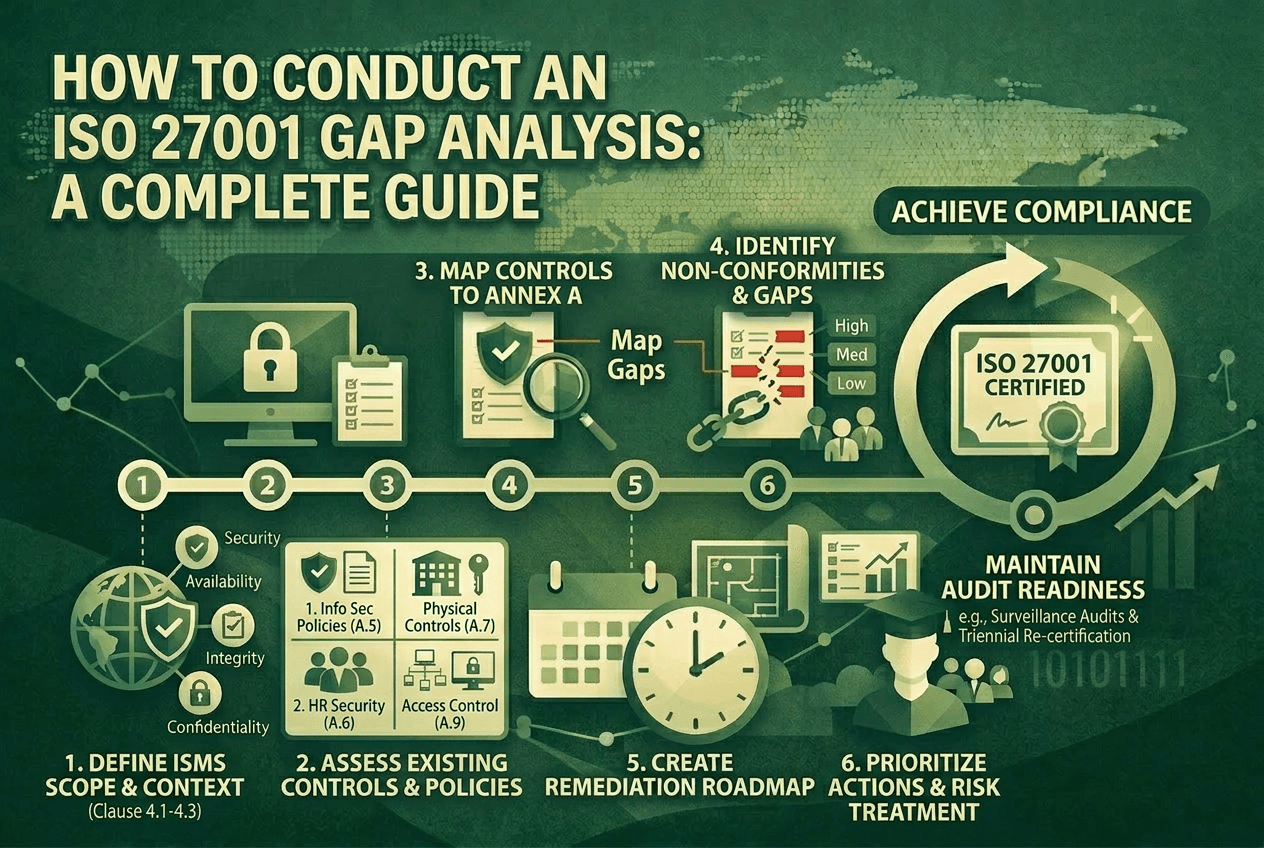
A gap assessment compares your current security practices against ISO 27001 requirements, identifying what you already have and what needs to be built or improved.
Review existing documentation, including current security policies, procedures, standards, and guidelines. Determine which documentation already exists and which needs to be created.
Assess current controls by inventorying existing security measures across access management, monitoring, incident response, physical security, and other areas. Map controls to ISO 27001 requirements.
Interview stakeholders to understand actual practices versus documented procedures. Often, organizations have sound security practices that aren't documented properly.
Identify major gaps requiring significant effort, such as missing risk assessments, inadequate documentation, unimplemented controls, or insufficient evidence-collection processes.
Prioritize remediation based on risk level, implementation complexity, and dependencies. Some gaps can be addressed quickly, while others require months of work.
Defining Your ISMS Scope
Your ISMS scope defines exactly what systems, locations, and processes are covered by ISO 27001. Getting this right is critical.
Identify in-scope systems, typically including production environments, customer data repositories, and critical business systems. Development and testing environments may be excluded if properly isolated.
Define geographic boundaries specifying which offices, data centers, or locations are included. Remote work arrangements need to be considered in modern implementations.
Specify organizational boundaries, clarifying which business units, departments, or subsidiaries are covered. Many organizations start with core operations and expand over time.
Document exclusions clearly, explaining what's out of scope and why. Valid business justifications for exclusions are acceptable, but the scope must cover all critical assets.
Create a scope statement as a formal document approved by leadership. This becomes a key artifact reviewed during certification audits.
Building Your Implementation Plan
Create a project timeline with realistic milestones for each implementation phase. Build in buffer time for unexpected delays or complications.
Assign responsibilities clearly for every primary task. Ambiguous ownership leads to gaps where vital work doesn't get done.
Allocate budget for tools, external support, training, and certification costs. Underestimating the budget creates mid-project problems.
Establish governance with regular steering committee meetings, status reporting, and escalation procedures for issues requiring leadership decisions.
Define success criteria beyond certification, including security improvements, process efficiency gains, and business-enabling outcomes.
Phase 2: Building Your ISMS Foundation
Establishing Governance and Leadership
Appoint key roles including Information Security Officer or ISMS owner with overall responsibility for the management system—document appointments with clear responsibilities.
Secure leadership commitment through formal approval of ISMS objectives, resource allocation decisions, and participation commitments for management reviews.
Define organizational structure showing reporting relationships, security committees, and escalation paths for security decisions.
Create a communication plan that ensures stakeholders understand the ISMS objectives, their responsibilities, and the program's benefits to the organization.
Developing Your Policy Framework
Information Security Policy serves as the overarching document establishing your commitment to information security and defining high-level principles.
Topic-specific policies address major control areas, including access control, acceptable use, incident response, change management, business continuity, vendor management, and data classification.
Procedures and standards provide detailed instructions for implementing policies, including step-by-step processes, technical configurations, and approval workflows.
Templates and forms support consistent execution, including incident report forms, access request templates, and risk assessment worksheets.
Policy development typically requires one to two months. Start with templates, but customize for your specific environment and requirements.
Conducting Risk Assessment
Risk assessment drives your entire control selection, making it the most critical ISMS activity.
Document risk methodology defining how you'll identify, analyze, and evaluate risks. Include your likelihood scale, impact criteria, and risk rating calculations.
Create asset inventory cataloging information assets, including databases, applications, infrastructure, data repositories, and third-party services. Classify assets by criticality and sensitivity.
Identify threats and vulnerabilities relevant to each asset. Consider cyberattacks, system failures, human error, vendor issues, natural disasters, and insider threats.
Assess likelihood and impact for each risk scenario using your defined methodology. Be realistic rather than theoretical in your assessments.
Calculate risk ratings combining likelihood and impact into overall risk scores. This prioritization drives where you invest security resources.
Determine risk treatment for each identified risk by choosing to accept, mitigate, transfer, or avoid. Document your decisions and rationale.
Create a Statement of Applicability selecting which ISO 27001 controls you'll implement based on your risk assessment and business context. Justify every inclusion and exclusion.
Phase 3: Implementing Security Controls
Technical Controls Implementation
Access management is a top priority for most organizations. Implement multi-factor authentication across all systems, establish role-based access control aligned with job functions, configure unique user IDs eliminating shared credentials, deploy privileged access management for administrators, and create quarterly access review processes.
Logging and monitoring provide visibility into security events and support incident detection. Deploy centralized logging through SIEM or log aggregation tools, configure comprehensive audit logging capturing access and changes, establish log retention meeting six-year requirements, implement security event alerting for suspicious activities, and create log review procedures.
Encryption and data protection safeguard information confidentiality. Enable encryption for data at rest using AES-256 or an equivalent algorithm, enforce encryption for data in transit using TLS 1.2 or higher, implement proper key management procedures, deploy data loss prevention where appropriate, and configure secure data disposal processes.
Vulnerability management identifies and addresses security weaknesses. Deploy vulnerability scanning tools, running monthly at minimum; establish patch management processes that apply critical patches within 30 days; conduct annual penetration testing by qualified testers; track vulnerabilities in a centralized register; and implement secure configuration baselines.
Network security protects infrastructure from unauthorized access. Deploy properly configured firewalls at network boundaries, implement network segmentation isolating sensitive systems, configure intrusion detection or prevention systems, establish secure remote access through VPN, and deploy anti-malware protection on all endpoints.
Administrative Controls Implementation
Security awareness training ensures the workforce understands their security responsibilities. Develop training content covering ISMS overview, security policies, acceptable use, incident reporting, and common threats. Deliver training to all employees within 30 days of hire. Conduct annual refresher training for the existing workforce. Track completion systematically with dates and attendees. Document training materials and attendance records. For more on this, see HIPAA Training for Employees.
Incident response establishes a systematic approach to handling security events. Create an incident response plan defining detection, reporting, triage, containment, eradication, and recovery procedures. Identify incident response team members with defined roles. Establish severity classification and escalation criteria. Develop communication templates for internal and external notifications. Conduct annual tabletop exercises testing procedures.
Change management maintains security during system modifications. Establish change-approval workflows that require documented authorization. Implement testing requirements before production deployment. Create rollback procedures for failed changes. Maintain change logs documenting all modifications. Separate duties between requestors, approvers, and implementers where possible.
Vendor risk management addresses third-party security risks. Create vendor inventory and identify all suppliers with data access. Classify vendors by risk level based on data sensitivity and criticality. Conduct security assessments appropriate to risk classification. Establish contractual security requirements in all vendor agreements and schedule periodic reassessments for ongoing monitoring.
Physical Security Controls
Facility access controls limit physical access to information processing facilities. Implement badge access systems for office entry and sensitive areas. Maintain visitor logs that document all visitors, including date, time, and purpose. Establish visitor escort requirements for non-employees. Configure physical barriers preventing unauthorized entry. Deploy security cameras in areas containing sensitive systems.
Workstation security protects endpoints from physical compromise—position workstations to prevent unauthorized viewing from public areas. Implement clean desk policies requiring information to be secured when unattended. Deploy cable locks for portable equipment. Establish secure equipment disposal procedures. Create policies for working with sensitive information in public locations.
Environmental controls protect infrastructure from environmental threats. Deploy fire detection and suppression systems in server rooms. Implement climate control to maintain appropriate temperature and humidity. Establish backup power through UPS and generator systems. Deploy water detection in areas with plumbing above the equipment. Create environmental monitoring with alerting for threshold violations.
Phase 4: Documentation and Evidence Collection
Creating Required Documentation
ISMS manual provides comprehensive documentation of your Information Security Management System including scope, policy framework, organizational structure, and process descriptions. Many organizations integrate this content into their policy documentation rather than creating a separate manual.
Risk assessment report documents your complete risk assessment, including methodology, asset inventory, identified risks, risk ratings, and treatment decisions. Update this at least annually and when significant changes occur.
Statement of Applicability lists all 93 ISO 27001 controls with implementation status, justification for inclusion or exclusion, and reference to implementing procedures or evidence. This becomes a critical audit artifact.
Procedures and work instructions provide detailed guidance for executing security processes. Key procedures include access provisioning and deprovisioning, incident response and escalation, change management approval, backup and recovery operations, physical security management, and vendor security assessment.
Records and logs demonstrate control over time. Maintain training completion records, access review documentation, incident response tickets, change approval records, audit logs, monitoring reports, backup test results, and vendor assessment documentation.
Establishing Evidence Collection Processes
Evidence collection should be continuous rather than crisis-driven before audits.
Automate where possible by configuring systems to export evidence automatically. Access review reports from identity providers, configuration snapshots from cloud platforms, vulnerability scan results from security tools, backup logs from backup systems, and training completion from learning management systems can often be automated.
Create a collection schedule defining who collects what evidence and how frequently. Quarterly activities typically include access reviews, log sampling, and backup testing. Monthly activities might consist of vulnerability scans and security-monitoring reviews.
Centralize storage in a structured repository that organizes, version-controls, and makes evidence easily retrievable. Many organizations use cloud storage with folders organized by control area.
Document procedures for evidence collection to ensure consistency when responsibilities transfer between team members.
Phase 5: Internal Audit and Management Review
Conducting Internal Audits
Internal audits are mandatory ISO 27001 requirements that must occur before certification and regularly thereafter.
Plan the audit by defining the scope, selecting auditors, scheduling interviews, and creating an audit checklist covering all ISMS requirements. The audit scope should cover the entire ISMS throughout the audit cycle.
Execute the audit through document review, interviews with process owners, testing of control effectiveness, and evidence examination. Take detailed notes documenting findings.
Document findings classifying observations as conforming, minor nonconformity, or major nonconformity. Provide specific details about what was observed and which requirement is affected.
Create an audit report summarizing audit activities, overall findings, specific nonconformities, and recommendations for improvement. Present the report to management.
Track corrective actions for all identified nonconformities, including assigned owners, target completion dates, and verification of effectiveness upon implementation. Most organizations conduct this 6 Months Before Certification.
Most organizations conduct internal audits six months before certification audits to allow time for corrective actions.
Holding Management Reviews
Management review is another mandatory requirement in which leadership evaluates the effectiveness of the ISMS.
Prepare review materials including ISMS performance metrics, internal audit results, security incidents and breaches, risk assessment updates, compliance status, and resource needs.
Conduct a review meeting with executive leadership participating. The review agenda should systematically cover all required topics. Allow time for questions and discussion.
Document decisions made during the review, including resource allocations, policy updates, security objective changes, and improvement initiatives approved.
Track action items with clear owners and deadlines for any improvements or changes decided during the review.
Management reviews should occur at least annually, with many organizations conducting them quarterly.
Phase 6: Certification Audit Preparation
Selecting Your Certification Body
Choose an accredited certification body with experience in your industry and geographic region.
Verify accreditation, ensuring the certification body is accredited by recognized bodies like ANAB, UKAS, or equivalent in your region. Unaccredited certifications have no value.
Consider industry experience: certification bodies with expertise in your sector who can better understand your specific challenges and requirements.
Evaluate cost and timeline which varies significantly between certification bodies. Get quotes from multiple providers.
Check reference customers speaking with other organizations they've certified to understand their audit approach and professionalism.
Stage 1 Audit: Documentation Review
Stage 1 is a documentation review occurring before the main audit.
Submit documentation including ISMS manual or equivalent, Statement of Applicability, risk assessment report, key policies and procedures, and organizational information.
Auditor reviews documentation for completeness and adequacy without testing implementation. They're verifying you have the required documentation structure.
Address findings from Stage 1 before proceeding to Stage 2. Common Stage 1 findings include incomplete Statement of Applicability, insufficient risk assessment documentation, missing required policies, or inadequate procedure detail.
Schedule Stage 2 typically four to six weeks after successful Stage 1 completion, allowing time to address any documentation gaps.
Stage 2 Audit: Implementation Assessment
Stage 2 evaluates whether your ISMS is actually implemented and operating effectively.
Prepare your team by briefing employees on what to expect, organizing evidence for easy retrieval, scheduling interviews with key personnel, and ensuring systems are accessible for auditor review.
Support auditor activities, including facility tours, system demonstrations, document review, and employee interviews. Assign someone to coordinate logistics and answer questions.
Track findings as auditors identify nonconformities or observations. Take notes on each finding to ensure you understand the concern.
Develop a corrective action plan for any nonconformities identified. Minor nonconformities can typically be addressed within 90 days. Major nonconformities may delay certification.
Receive certification decision typically within two weeks after the Stage 2 audit if no major nonconformities exist.
Maintaining Your ISO 27001 Certification
Annual Surveillance Audits
Certification lasts 3 years but requires annual surveillance audits to remain valid.
Surveillance scope covers a subset of ISMS requirements each year, ensuring all areas are reviewed over the three-year cycle. Audits are lighter than initial certification but still substantive.
Prepare similarly to initial certification by gathering evidence, reviewing controls, and ensuring documentation remains current.
Demonstrate continuous improvement showing how you've evolved your ISMS based on lessons learned, incidents, or changing requirements.
Ongoing ISMS Operation
Maintain risk assessments through quarterly reviews, adding new risks, updating existing ratings, and tracking treatment progress.
Conduct internal audits at least annually, with many organizations operating on six-month cycles for better continuous monitoring.
Hold management reviews quarterly or annually, depending on organization size and risk profile.
Update documentation as processes change, new systems are added, or organizational structure evolves.
Collect evidence continuously rather than scrambling before audits. Ongoing collection significantly reduces the audit preparation burden.
Train employees including onboarding training for new hires and annual refresher training for existing workforce.
Monitor and measure ISMS performance through security metrics, incident trends, and control effectiveness indicators.
Common Implementation Challenges and Solutions
Challenge: Insufficient Leadership Support
Implementation stalls when leadership treats ISO 27001 as a compliance project rather than a strategic initiative.
Solution: Frame ISO 27001 in business terms showing how it enables sales, reduces risk, and improves operational efficiency. Provide regular executive updates highlighting progress and business benefits. Include leadership in key decisions through management reviews.
Challenge: Resource Constraints
Organizations underestimate the time and budget required for effective implementation.
Solution: Develop realistic project plans accounting for competing priorities. Consider external support for specialized tasks, such as internal audits or gap assessments—leverage automation to collect evidence and monitor progress, reducing the ongoing burden.
Challenge: Documentation Overload
Teams create excessive documentation that becomes difficult to maintain and doesn't reflect actual practices.
Solution: Start with templates and customize minimally. Focus on documenting what you actually do rather than theoretical ideal states. Integrate ISMS documentation with existing process documentation to reduce duplication.
Challenge: Employee Resistance
Workforce views security controls as obstacles to productivity rather than enablers of secure work.
Solution: Communicate the 'why' behind requirements, helping employees understand the business benefits and customer expectations. Design controls balancing security with usability. Provide easy ways to report security concerns or suggest improvements.
Challenge: Keeping Documentation Current
Policies and procedures become outdated as systems and processes evolve.
Solution: Assign clear ownership and review responsibilities for each policy area. Schedule annual policy reviews on the calendar. Build documentation updates into change management processes. Use version control to track changes over time.
Conclusion: Your Path to ISO 27001 Certification
ISO 27001 implementation represents a significant investment of time and resources, but the benefits extend far beyond certification. Organizations that implement ISO 27001 effectively build security programs that genuinely reduce risk, enable business growth, and create competitive advantages.
The implementation journey typically spans 9 to 12 months, from initial planning through certification. Organizations with existing security programs, particularly those with SOC 2 compliance, can often accelerate this timeline by leveraging existing controls and documentation.
Success requires systematic execution across all implementation phases: conducting thorough gap assessments, building solid ISMS foundations, implementing appropriate controls, continuously collecting evidence, performing internal audits, and thoroughly preparing for certification audits.
The most successful implementations treat ISO 27001 as a business program rather than a compliance project. When security becomes systematic rather than reactive, organizations benefit from reduced incidents, faster sales cycles, improved operational efficiency, and stronger security postures.
Modern tools and platforms can significantly accelerate ISO 27001 implementation. Automated evidence collection, centralized documentation management, control mapping across frameworks, and continuous compliance monitoring transform what traditionally required extensive manual effort into streamlined processes.
Ready to Accelerate Your ISO 27001 Implementation?
Don't let manual documentation slow down your path to enterprise deals. Book a free DSALTA demo today to see how our platform automates 70% of the work, manages your Statement of Applicability, and maintains continuous audit-readiness.
Explore more ISO 27001 articles
ISO 27001 Implementation & Certification
Stop losing deals to compliance.
Get compliant. Keep building.
Join 100s of startups who got audit-ready in days, not months.