Step-by-Step ISO 27001 Risk Assessment Guide for Startups
Written by
Published on
Dec 31, 2025
Conducting an ISO 27001 risk assessment
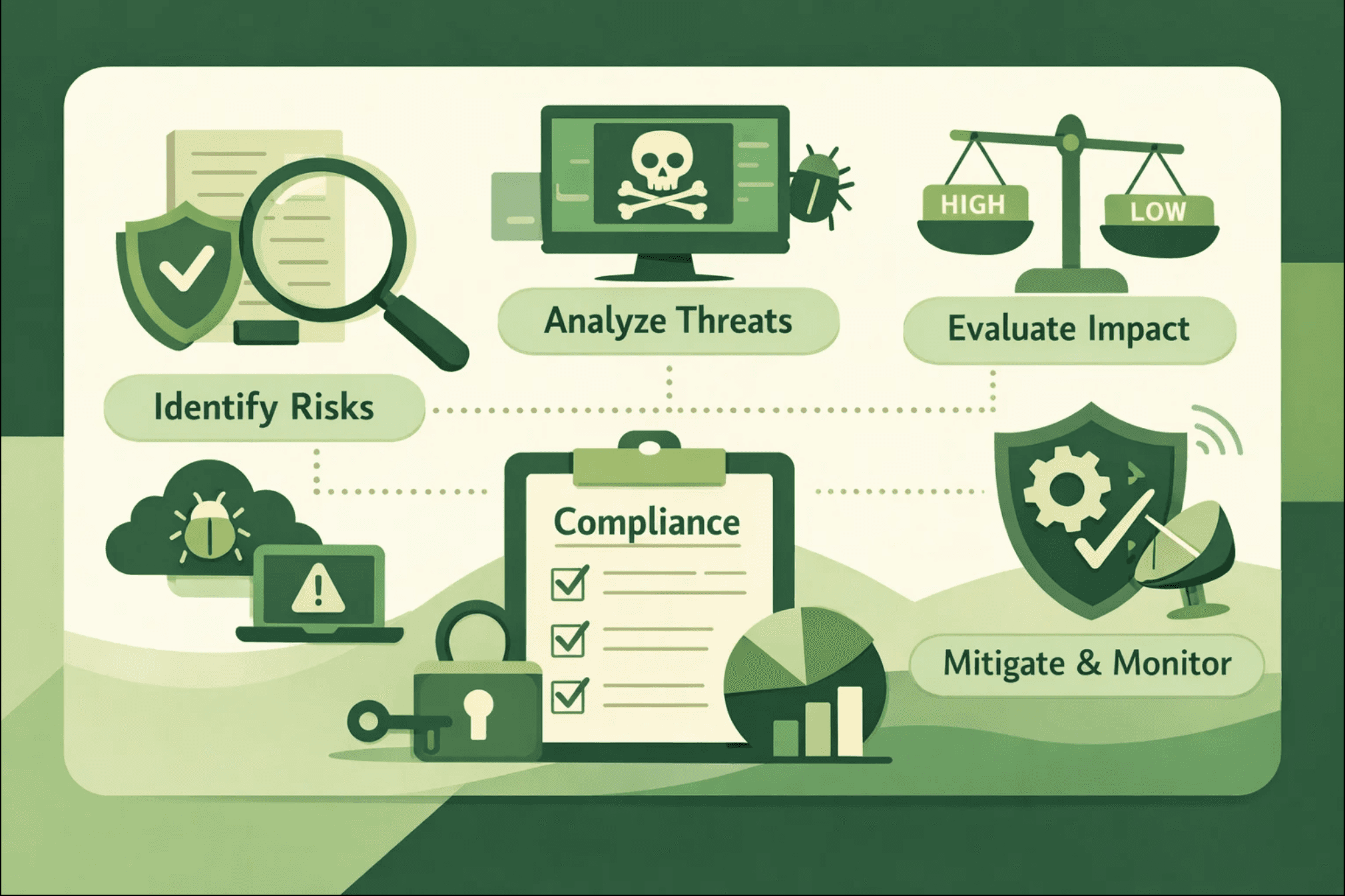
It is one of the most critical steps in building a robust Information Security Management System (ISMS). It's not just about checking a compliance box—it's about understanding where your vulnerabilities lie, what threats could exploit them, and how to protect what matters most to your business.
For startups and growing companies, getting this right from the start can save countless hours during ISO 27001 certification and create a security foundation that scales with your organization.
Why ISO 27001 Risk Assessment Matters
Under the ISO 27001:2022 standard, a structured risk assessment isn't optional—it's mandatory. This process helps you:
Identify information security risks across your entire organization
Analyze and evaluate which risks pose the greatest threat
Prioritize resources to address high-impact vulnerabilities first
Justify the control selection to the auditors during your certification audit
Build a repeatable methodology that supports continuous improvement
Without a documented risk assessment, you can't demonstrate that your security controls are proportionate to actual threats. This is what separates a true ISMS from a collection of random security policies.
Think of it this way: your risk management framework tells the story of why you've implemented specific controls, making your entire compliance program defensible and strategic.
The Six-Step ISO 27001 Risk Assessment Process
1. Define Your Risk Assessment Methodology
Before identifying a single risk, you need a consistent approach to evaluate them. Your risk assessment methodology should document:
What qualifies as an information security risk in your organization
How you'll measure likelihood and impact (qualitative scales, quantitative metrics, or both)
Who owns each risk (typically department heads or process owners)
Your risk appetite—the level of risk your organization is willing to accept
Criteria for risk treatment decisions (mitigate, accept, transfer, or avoid)
This methodology serves as your north star throughout the risk process. It must be documented, approved by leadership, and consistently applied across all assets and risks.
Why this matters for auditors: During your ISO 27001 internal audit or certification audit, assessors will verify that you followed your stated methodology. Inconsistency here is a significant finding.
2. Identify Information Assets and Risks
Now you're ready to catalog what you're protecting and what could threaten it.
Start by listing your information assets:
Hardware (servers, laptops, network equipment)
Software and applications
Data (customer information, intellectual property, financial records)
People (employees, contractors with system access)
Processes and workflows that handle sensitive information
For each asset, identify:
Threats that could exploit it (cyberattacks, human error, natural disasters)
Vulnerabilities that make those threats possible (unpatched systems, weak passwords, lack of encryption)
This becomes your risk register—a living document that maps "what we have → what could go wrong → how bad it could be."
Pro tip: Don't try to identify every conceivable risk. Focus on realistic scenarios relevant to your business context. A fintech startup's risks look very different from those of a healthcare provider.
3. Analyze and Prioritize Risks
For each identified risk, you need to answer two questions:
How likely is this to happen? (Low, Medium, High)
What would the impact be if it did? (Minor, Moderate, Severe, Critical)
Most organizations use a likelihood-versus-impact matrix to score risks numerically. For example:
Likelihood: Rare (1), Unlikely (2), Possible (3), Likely (4), Almost Certain (5)
Impact: Negligible (1), Minor (2), Moderate (3), Major (4), Catastrophic (5)
Risk Score: Likelihood × Impact
This scoring helps you sort risks and focus on the ones that truly matter. A low-likelihood but catastrophic-impact risk (like a ransomware attack) may warrant more attention than a high-likelihood, low-impact risk (like a forgotten password).
Control mapping insight: Your highest-scored risks should directly correspond to your most robust control activities and ISO 27001 controls implementation.
4. Decide on Risk Treatment Options
Now comes the strategic part: deciding how to handle each risk. ISO 27001 recognizes four treatment approaches:
Mitigate: Implement controls to reduce the likelihood or impact
Most common approach
Examples: MFA (multi-factor authentication), data encryption, regular vulnerability scanning, patch management
Accept: Acknowledge the risk and decide not to act
Appropriate for risks below your risk appetite
Requires documented justification and management approval
Transfer: Share or shift the risk to a third party
Examples: Cyber insurance, cloud service providers with contractual SLAs, vendor attestations
Avoid: Eliminate the risk by changing how you operate
Example: Discontinuing a vulnerable legacy system
Your treatment decisions should be documented in a risk treatment plan that maps each risk to specific controls. This plan becomes the foundation for your Statement of Applicability (SoA)—the document that lists which Annex A controls you've implemented and why.
5. Document Everything for Audit Readiness
Documentation isn't bureaucracy—it's how you prove your ISMS works. You'll need:
Risk Assessment Report:
Methodology used
Assets identified
Risks found and scored
Analysis summary
Risk Treatment Plan:
Each risk and its treatment approach
Specific controls implemented
Responsible parties
Implementation timelines
Statement of Applicability (SoA):
All 93 Annex A controls
Which ones you've implemented
Justification for inclusion or exclusion
References back to your risk findings
Evidence Collection:
Screenshots of risk register updates
Meeting minutes from risk review sessions
Control implementation evidence
Management inquiry records showing leadership involvement
This documentation isn't just for auditors—it's how you demonstrate continuous compliance and continuous improvement (the PDCA cycle: Plan-Do-Check-Act).
6. Monitor and Review Regularly
ISO 27001 requires ongoing risk management, not a one-time exercise. Build these activities into your compliance program lifecycle:
Regular reviews (at least annually, more often for critical systems):
Update your risk register as new threats emerge
Reassess risks when business context changes (new products, markets, technologies)
Verify existing controls remain effective
Continuous monitoring:
Track new vulnerabilities through vulnerability management processes
Review access logs and security incidents
Monitor vendor risk for third-party service providers
Update your risk treatment plan:
Adjust controls based on effectiveness data
Add controls for newly identified risks
Retire controls that no longer address current threats
This cycle keeps your ISMS alive and relevant. It's also how you prepare for surveillance audits and eventual recertification.
Connecting Risk Assessment to ISO 27001 Certification
Your risk assessment isn't a standalone document—it's the strategic core that connects everything in your ISO 27001 certification journey:
For Control Selection: Your risk findings directly justify which of the 93 Annex A controls you implement. Can't justify why you need a control? You probably don't need it. Can't show a risk that warrants a particular control? Auditors will question it.
For the Statement of Applicability: The SoA is essentially a control mapping exercise that traces each implemented control back to specific risks. Your risk assessment makes this connection explicit and defensible.
For Certification Audits: Auditors will review your risk assessment to verify:
You followed your documented methodology
Risks are realistic and well-analyzed
Treatment decisions are proportionate
Controls align with risk priorities
Documentation is complete and maintained
For Continuous Improvement: Your risk register becomes the input for ongoing ISMS refinement. New risks emerge, old ones diminish. Your risk-based compliance approach adapts accordingly.
ISO 27001 Risk Assessment vs. Other Frameworks
If you're managing multiple compliance certifications, you'll find overlap:
ISO 27001 vs SOC 2: Both require risk assessments, but SOC 2 focuses more on Trust Services Criteria (Security, Availability, Confidentiality, Processing Integrity, Privacy) while ISO 27001 takes a broader ISMS approach.
ISO 27001 + NIST CSF: The NIST CSF (Cybersecurity Framework) complements ISO 27001 nicely. Many organizations use NIST's Identify-Protect-Detect-Respond-Recover framework alongside ISO's risk-based methodology.
ISO 27001 + GDPR: Your ISO risk assessment should absolutely include data protection and privacy risks relevant to GDPR compliance, including cross-border data transfers, data minimization, and data breach notification requirements.
The good news? A well-structured ISO 27001 risk assessment can satisfy requirements across multiple frameworks, reducing duplication in your compliance management efforts.
Common Pitfalls to Avoid
Being too generic: "Data breach" isn't a useful risk. "Unauthorized access to customer PII in production database due to SQL injection vulnerability" is specific and actionable.
Ignoring people and processes: Technical controls matter, but human error and procedural gaps are often the weakest links. Include administrative safeguards and training in your risk treatment.
Setting unrealistic risk appetite: If you say you'll accept no risks above "Low," you'll either implement controls for everything (expensive) or constantly violate your own policy (audit finding).
Treating it as one-and-done: Risk changes constantly. Your assessment must too, or it becomes a compliance artifact rather than a helpful tool.
Forgetting vendor risk: Third-party service providers represent some of your most significant risks. Include vendor risk management, vendor due diligence, and third-party risk assessment in your process.
Practical Tools and Templates
To get started efficiently:
Risk register templates: Simple spreadsheets work for startups. Include columns for asset, threat, vulnerability, likelihood, impact, score, treatment, control, and owner.
Risk assessment methodology: Document your scoring system, treatment criteria, and review frequency in a 2-3 page methodology document.
Risk treatment plan: Track each risk, its treatment approach, assigned controls, responsible parties, and implementation status.
Compliance platforms: Tools like DSALTA can automate much of the evidence collection, control mapping, and remediation tracking work, especially as you scale.
Final Thoughts: From Compliance Checkbox to Strategic Advantage
An ISO 27001 risk assessment doesn't have to be mysterious or overwhelming. Start with a transparent methodology, be honest about what you're protecting and what threatens it, document your decisions, and review regularly.
The factories referenced in manufacturing contexts have a relevant lesson for compliance teams: you can't automate or scale what you haven't first structured and understood. Similarly, you can't secure what you haven't risk-assessed.
Done right, your risk assessment becomes more than a certification requirement; it becomes the strategic foundation for all your information security management decisions. It tells you where to invest, what controls to prioritize, and how to demonstrate to customers, investors, and auditors that you take security seriously.
When your next ISO 27001 audit arrives, you won't be scrambling to justify your controls. You'll have a clear, documented trail from identified risks to implemented protections—precisely what the standard demands and what your business deserves.
Ready to streamline your ISO 27001 compliance journey? Learn how DSALTA helps teams automate risk assessments, evidence collection, and audit readiness across ISO 27001, SOC 2, GDPR, and other frameworks.
Explore more ISO 27001 articles
ISO 27001 Implementation & Certification
Stop losing deals to compliance.
Get compliant. Keep building.
Join 100s of startups who got audit-ready in days, not months.