HIPAA —
Essential Data Security Compliance Controls for Healthcare & Finance
Complete guide to data security compliance for healthcare and finance. Learn daily security controls, monitoring strategies, and best practices to protect sensitive data.
Dogan Akbulut
Data Security & Protection
Share this article


Introduction: Why Data Security Compliance Matters More Than Ever
A financial services firm loses 2.3 million customer records through a misconfigured cloud database. A hospital system pays $4.3 million in ransomware demands after patient files are encrypted and become inaccessible. A payment processor faces $18 million in regulatory fines for inadequate data security controls and failed PCI DSS compliance.
These aren't isolated incidents—they represent the daily reality of organizations struggling with data security compliance in heavily regulated industries. Healthcare and finance handle society's most sensitive information: medical records, financial transactions, personally identifiable information, and protected health data. When security fails in these sectors, the consequences extend far beyond financial penalties to include damaged patient care, disrupted financial services, and shattered public trust.
The challenge? Data security compliance isn't a one-time certification or annual audit preparation. It requires daily operational controls, continuous monitoring, and systematic processes that protect data while enabling business operations. Organizations must simultaneously satisfy multiple compliance frameworks—HIPAA for healthcare, PCI DSS for payment processing, SOC 2 for service providers, GDPR for privacy, and GLBA for financial institutions—while defending against increasingly sophisticated cyber threats.
This comprehensive guide explains what data security compliance actually means in practice, the specific controls healthcare and finance organizations need, how to implement effective daily monitoring, and strategies for maintaining compliance without overwhelming your team. It also shows how AI-powered compliance management platforms can automate evidence collection, control testing, and reporting so you stay continuously audit-ready.
Understanding Data Security Compliance in Regulated Industries
Data security compliance involves implementing technical, administrative, and physical controls to protect sensitive information in accordance with regulatory standards and industry requirements. It's not just about passing audits but about building information security management programs that genuinely reduce risk while demonstrating accountability to regulators, customers, and auditors.
Why Healthcare and Finance Face Stricter Requirements
The sensitivity of data handled by these industries explains heightened regulatory scrutiny. Healthcare organizations manage complete medical histories, diagnoses, treatment plans, prescription records, insurance information, and genetic data classified as Protected Health Information (PHI) under HIPAA. Financial institutions process account numbers, transaction histories, Social Security numbers, credit information, investment portfolios, and loan applications regulated under GLBA, PCI DSS, and privacy laws like GDPR.
The value to criminals makes healthcare and finance prime targets. Medical records sell for far more than credit card numbers on dark web markets because they contain comprehensive identity information enabling fraud, identity theft, and insurance scams. Financial data enables account takeovers, wire fraud, card-not-present fraud, and long-term financial crime.
The potential for harm extends beyond financial loss. Compromised medical records can lead to incorrect treatments, insurance fraud, and life-threatening medical errors. Breached financial data enables account takeovers, fraudulent transactions, and long-term economic damage. Regulators recognize this and shape requirements accordingly.
The regulatory landscape reflects these risks through strict requirements. HIPAA governs healthcare data with significant penalties for violations. GLBA mandates financial institution safeguards. PCI DSS controls payment card processing. GDPR and other privacy laws regulate personal data handling. SOC 2 demonstrates security for service providers. Organizations often must satisfy multiple frameworks simultaneously, making a unified, risk-based approach essential.
The Core Components of Data Security Compliance
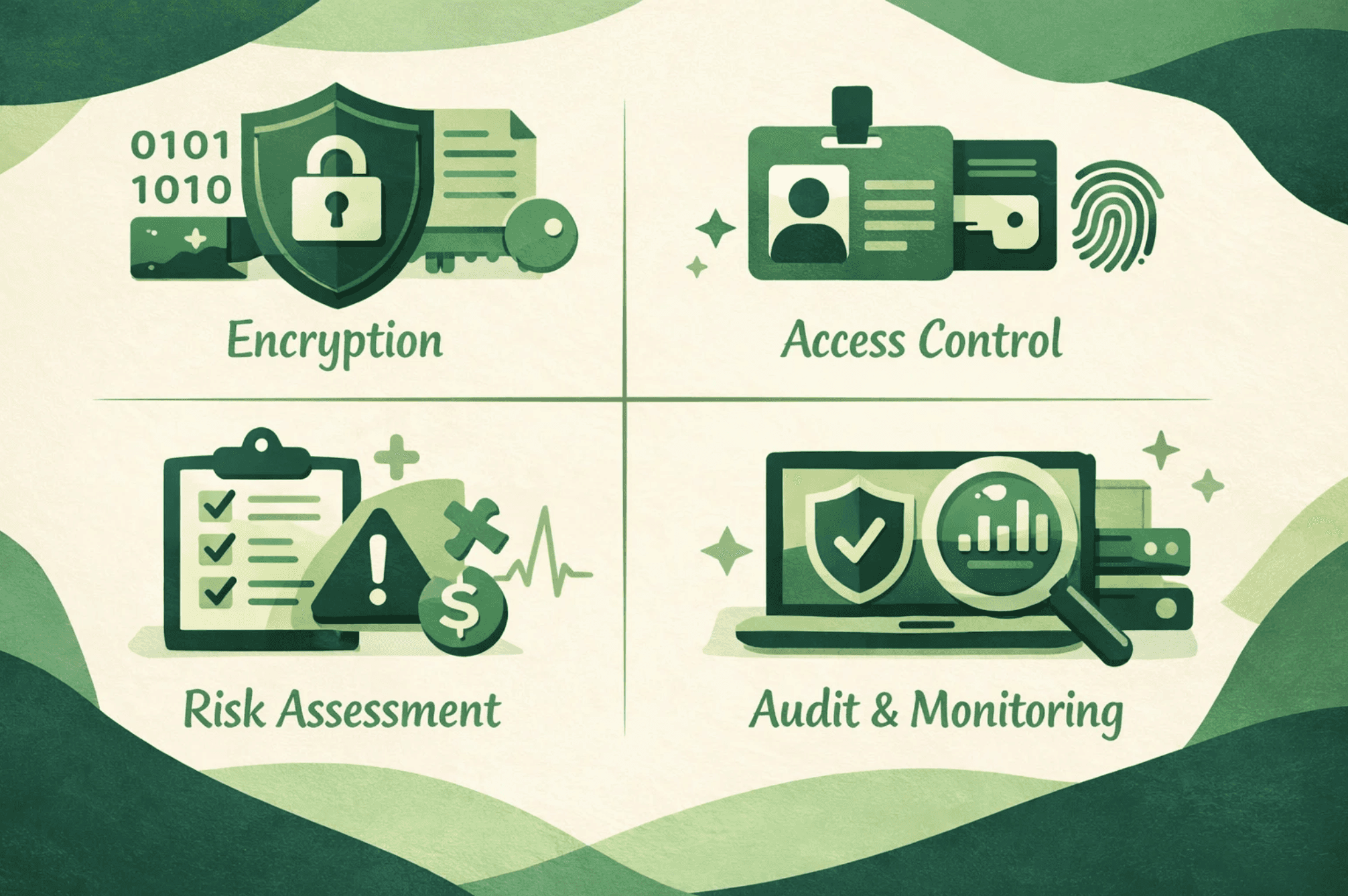
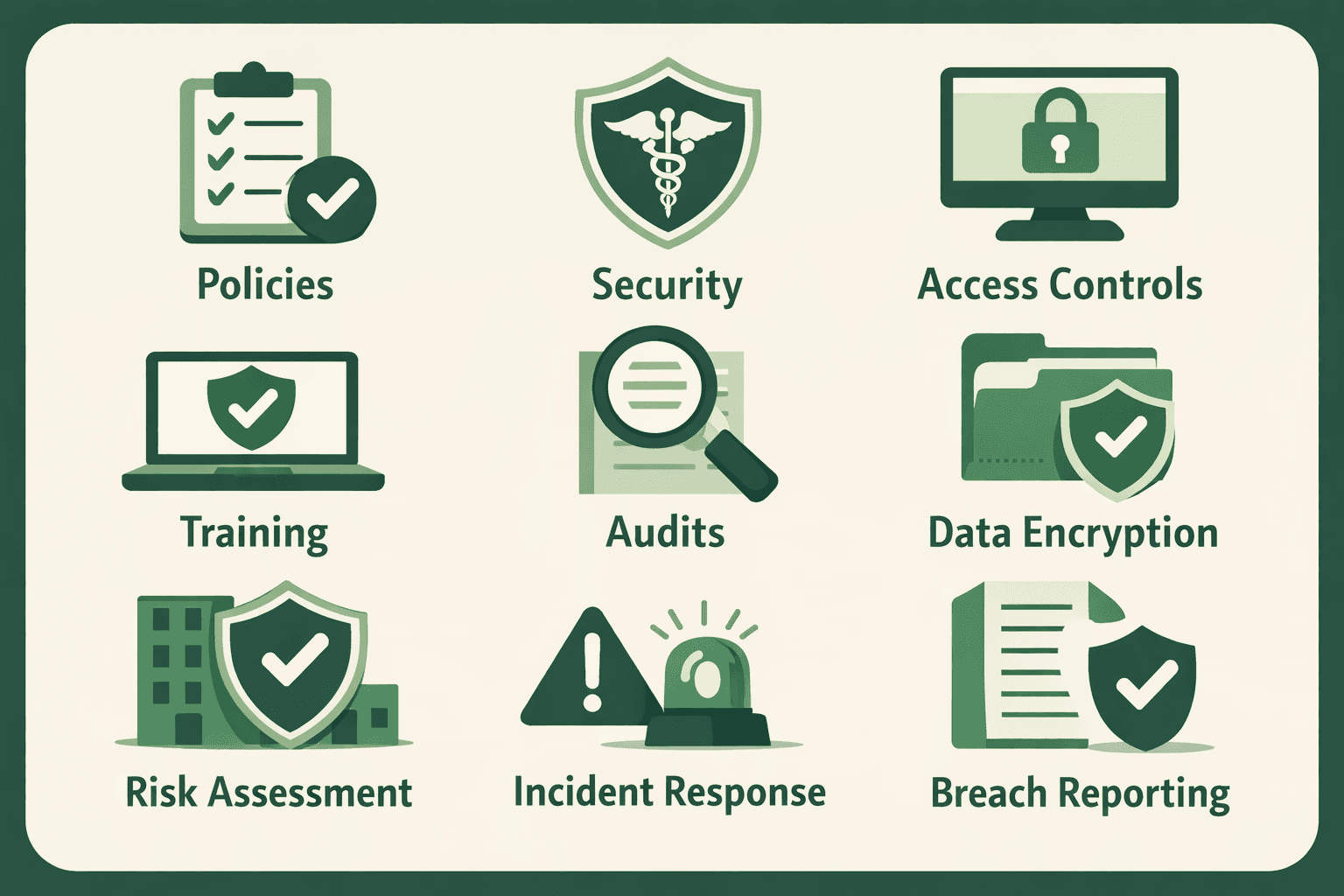
Access control ensures only authorized individuals can view or modify sensitive data. This includes user authentication, role-based permissions, access reviews, and privileged account management aligned with SOC 2, HIPAA, and ISO 27001 expectations.
Encryption protects data both at rest in storage systems and in transit across networks. Strong encryption and sound key management are central requirements in frameworks like PCI DSS, GDPR, and ISO 27001.
Monitoring and logging create visibility into who accesses data, when access occurs, what actions are taken, and whether unusual patterns emerge. Audit trails support incident investigation and compliance verification, and map directly to SOC 2 Security and HIPAA Security Rule requirements.
Incident response establishes procedures for detecting, containing, investigating, and recovering from security events. Quick, effective response limits damage and satisfies regulatory notification requirements under HIPAA, GDPR, and sector regulators.
Vendor management extends security controls to third-party providers handling sensitive data. Vendor risk management programs with assessments, Business Associate Agreements, and continuous monitoring ensure vendors maintain appropriate protections.
Risk assessment identifies vulnerabilities, evaluates threats, determines likelihood and impact, and drives the implementation of controls. Regular risk assessments keep security aligned with evolving threats and business changes and support frameworks like SOC 2 and ISO 27001.
Policy and training establish expectations, procedures, and accountability. Workforce members must understand their responsibilities and the consequences of violations, with completion tracked in your compliance management system.
Daily Data Security Controls for Healthcare Organizations
Morning Security Checks That Prevent Incidents
Review overnight security alerts from your SIEM or monitoring system. Look for failed login attempts, unusual access patterns, suspicious file transfers, or system anomalies in EHR and clinical systems. Prioritize alerts that indicate PHI access anomalies or potential ransomware.
Verify backup completion for all systems containing Protected Health Information. Check backup logs for failures, validate data integrity, confirm encryption, and verify offsite storage—all of which support HIPAA and SOC 2 Availability criteria.
Check access provisioning requests from the previous day. Ensure new employees have appropriate access based on their roles, terminated employees have been completely removed from all systems, and access changes were properly approved, aligning with SOC 2 logical access controls and HIPAA workforce access safeguards.
Monitor vendor connections to your systems. Verify that third-party access remains within authorized parameters and that no unexpected vendor connections occurred overnight. This supports your third-party risk management responsibilities and Business Associate obligations.
Review patient data access logs, looking for inappropriate access patterns: staff accessing their own records, celebrity patient records, or records outside their department warrant immediate investigation under HIPAA minimum necessary standards.
Continuous Monitoring Throughout the Day
Real-time alerting for critical security events enables immediate response. Configure alerts for ransomware indicators, unauthorized PHI exports, privileged account usage, failed authentication patterns, and system configuration changes that impact compliance.
Network traffic monitoring detects unusual data flows that might indicate exfiltration attempts. Unexpected large file transfers, connections to suspicious external IPs, or unusual protocol usage in clinical networks require rapid investigation.
Endpoint monitoring tracks activity on workstations, laptops, and mobile devices accessing PHI. Monitor for malware indicators, unauthorized software installation, USB device usage, and policy violations that could lead to breaches.
User behavior analytics establishes baseline patterns for regular activity and flags deviations. An employee suddenly accessing hundreds of patient records or downloading unusually large volumes of data triggers alerts that support both security and compliance reporting.
Application monitoring tracks electronic health record systems, billing applications, and other critical platforms. Monitor for unauthorized access attempts, unusual query patterns, or system performance issues indicating attacks or misconfigurations that could compromise PHI.
End-of-Day Security Procedures
Review access logs for any unusual patterns that didn't generate real-time alerts but merit investigation. Focus on after-hours access, weekend activity, and access by temporary or contractor accounts across systems in your HIPAA and SOC 2 scope.
Verify all systems remain compliant with security configurations. Automated configuration monitoring should confirm that encryption settings, password policies, audit logging, and other controls remain properly configured in line with your framework requirements.
Document any incidents that occurred during the day, even minor ones. Record what happened, response actions taken, investigation findings, and preventive measures implemented, preserving evidence for regulators and auditors.
Prepare briefing for overnight security team if you have 24/7 coverage. Highlight any ongoing investigations, systems under maintenance, expected activity, or elevated threat indicators to ensure continuity.
Update the risk register if you identify new vulnerabilities, experience incidents, or make significant system changes. Keeping your risk management framework current is key to defensible compliance.
Daily Data Security Controls for Financial Institutions
Transaction Monitoring and Fraud Detection
Real-time transaction screening applies rules-based and machine-learning models to detect potentially fraudulent activity, flagging unusual transaction amounts, rapid transaction sequences, geographic anomalies, and behavior inconsistent with customer patterns. These controls align with financial regulators’ expectations for fraud prevention.
Payment system monitoring tracks authorization rates, decline patterns, and processing anomalies that might indicate fraud or system compromise. Sudden spikes in declined transactions or authorization failures warrant investigation, especially where PCI DSS applies.
Account access monitoring detects credential stuffing attempts, account takeover indicators, and suspicious login patterns. Multiple failed logins followed by success, logins from unusual locations, or simultaneous logins from different regions raise red flags.
Wire transfer controls implement dual authorization for large transfers, verify recipient information through secondary channels, and scrutinize destination accounts. Wire fraud remains a significant threat requiring enhanced controls and strong audit trails.
ATM and card transaction monitoring identifies skimming attempts, unusual withdrawal patterns, and compromised card indicators. Geographic anomalies, such as cards used in multiple countries within hours, point to compromise and require quick card reissuance.
Customer Data Protection Controls
Data access logging records every access to customer financial information, including who accessed the data, when, what information was viewed, and from which system or location. These logs support incident investigation and regulatory inquiries.
Segregation of duties prevents single individuals from having complete control over critical processes. Separate transaction initiation from approval, customer service access from modification privileges, and security administration from security monitoring to reduce fraud risk.
Encryption key management protects the encryption keys that secure customer data. Store keys separately from encrypted data, rotate keys periodically, and strictly control key access, aligning with ISO 27001 and regulator guidance.
Data loss prevention monitors for unauthorized attempts to export customer data. Block email attachments containing sensitive financial information, prevent uploads to unauthorized cloud storage, and alert on large-scale data access or transfer anomalies.
Customer authentication implements multi-factor authentication for online banking, mobile applications, and sensitive transactions. Strong authentication supports both SOC 2 Security and various banking regulations.
Compliance Monitoring and Reporting
Regulatory change tracking monitors for updates to applicable regulations, including GLBA, state privacy laws, PCI DSS updates, and federal banking regulations. Assess impact on your control framework and update policies and procedures accordingly.
Compliance metric dashboards provide real-time visibility into the effectiveness of controls. Track metrics such as the percentage of employees with current training, access reviews completed on schedule, vulnerability remediation timeframes, and incident response times in a centralized compliance dashboard.
Audit preparation activities maintain continuous audit-readiness rather than scrambling before scheduled audits. Keep documentation current, evidence organized, and policies up to date across SOC 2, PCI DSS, and internal audits.
Regulatory reporting preparation tracks incidents requiring disclosure to regulators, customers, or credit bureaus. Maintain documentation supporting notification decisions, timelines, and actions taken.
Implementing Effective Security Monitoring Systems
Building Your Monitoring Foundation
Centralized log collection aggregates security logs from all systems into a central location for analysis. Include logs from servers, applications, network devices, security tools, and cloud services so you can support both operational security and audit evidence needs.
Security Information and Event Management platforms correlate events across systems to detect complex attack patterns. They are especially effective when integrated with your automated control testing and evidence-collection workflows.
User and Entity Behavior Analytics establishes baselines for normal behavior and identifies anomalies. Statistical models detect subtle deviations that rule-based systems miss, improving both detection and compliance visibility.
Cloud security monitoring extends visibility to cloud environments, including infrastructure configurations, access patterns, and data flows across AWS, Azure, GCP, or SaaS platforms that store regulated data.
Endpoint Detection and Response provides deep visibility into endpoint activity, including process execution, file modifications, network connections, and registry changes. EDR helps detect sophisticated threats that evade traditional antivirus and provides rich forensic data for incident reports.
Configuring Effective Alerts
Reduce alert fatigue through careful tuning. Too many false positives cause analysts to ignore alerts, missing genuine threats. Start with high-fidelity alerts and expand gradually as your team and tooling mature.
Prioritize based on risk so analysts focus on alerts indicating the most significant potential damage. Alerts suggesting ransomware, PHI exfiltration, or payment data compromise warrant immediate response, while low-impact alerts can be handled in batches.
Provide context in alerts to enable faster triage. Include affected system details, user information, related events, and suggested response actions so analysts can quickly decide how to respond.
Escalate appropriately based on alert severity and time. Critical alerts page on-call personnel immediately, while lower-priority alerts queue for business hours review. Escalation paths should align with your documented incident response plan.
Track metrics on alert volume, false positive rates, mean time to detect, and mean time to respond. Use metrics to improve monitoring effectiveness and demonstrate maturity to auditors and regulators.
Creating Actionable Dashboards
Executive dashboards provide high-level visibility into the security posture for leadership. Show overall risk trends, compliance status across frameworks like HIPAA, PCI DSS, SOC 2, and GDPR, incident statistics, and high-level resource allocation.
Operational dashboards provide security teams with the real-time information needed for daily operations. Display current alerts, system health, threat intelligence, investigation status, and open remediation tasks.
Compliance dashboards track the effectiveness of controls against regulatory requirements. Show training completion rates, access review status, vulnerability remediation progress, and audit findings, powered by your live compliance dashboard.
Trend analysis views identify patterns over time. Compare the current week to previous weeks, the current month to last month, and year-over-year trends for incidents, control failures, and remediation performance.
Practical Tips for Maintaining Daily Compliance
Automating Routine Compliance Tasks
Automated evidence collection continuously gathers compliance documentation rather than manually collecting it before audits. Use integrations to sync logs, scans, and control status from connected systems so evidence stays current and audit-ready.
Scheduled access reviews generate reports of user access rights and route them to appropriate managers for review. Track review completion and automatically escalate overdue reviews, providing clear access review evidence for SOC 2 and HIPAA.
Vulnerability scanning runs automatically on defined schedules, identifies security weaknesses, prioritizes based on risk, and generates remediation tickets. Integrate with ticketing systems to track closure and report on remediation timelines.
Policy acknowledgment tracking automatically sends policies to employees, tracks who has reviewed and acknowledged them, and sends reminders to those who haven't responded. This supports HIPAA, GDPR, and internal policy compliance.
Training assignment and tracking enroll employees in required training based on role, track completion, send reminders, and generate compliance reports automatically—functions often centralized in compliance management platforms.
Building Effective Documentation Habits
Document as you go rather than trying to reconstruct activities later. When you investigate an alert, document immediately. When you implement a new control, capture configuration details, screenshots, and testing evidence.
Use templates for everyday documentation needs, including incident reports, access review logs, risk assessments, and vendor evaluations. Templates ensure consistency and completeness across frameworks like SOC 2, HIPAA, and PCI DSS.
Centralize storage in a single system of record for compliance documentation. Whether you use a dedicated compliance management solution or another platform, maintain one authoritative source to simplify audits.
Version control tracks changes to policies, procedures, and configurations over time. Auditors often request to see policy versions in effect during specific timeframes or at the time of particular incidents.
Organize logically using consistent naming conventions and folder structures. When auditors request documentation aligned to specific controls or requirements, you should be able to locate it within minutes.
Creating Sustainable Processes
Integrate compliance into operations rather than treating it as separate work. When developers deploy code, security reviews and approvals happen as part of the process. When employees are onboarded, training and access provisioning follow defined workflows that satisfy multiple frameworks.
Assign clear ownership for each compliance control. Someone must be accountable for ensuring access reviews happen, risk assessments are updated, training is completed, vendor reviews occur, and evidence is maintained.
Right-size your program for your organization's maturity and resources. Smaller organizations can start with a core set of controls mapped across SOC 2, HIPAA, PCI DSS, and GDPR, then expand as complexity grows.
Leverage existing tools before purchasing new ones. Many organizations already have identity providers, cloud platforms, and security tools with compliance-relevant features that can feed into their compliance dashboards.
Schedule regular reviews of your compliance program itself. Evaluate what's working well, where manual work is still heavy, and where automation or process improvements would have the biggest impact.
Common Data Security Compliance Mistakes to Avoid
Compliance Theater vs. Real Security
Organizations sometimes implement controls that look good on paper but don't actually reduce risk. Security questionnaires get answered perfectly while actual security remains weak because controls are poorly implemented or inconsistently applied.
The solution: Focus on controls that genuinely protect data. Ask whether each control prevents specific threats or just checks compliance boxes. Align your controls with ISO 27001, SOC 2, and GDPR in a way that makes technical and operational sense.
Point-in-Time Compliance
Some organizations operate on an annual audit cycle, scrambling before audits
Explore more HIPAA articles
Stop losing deals to compliance.
Get compliant. Keep building.
Join 100s of startups who got audit-ready in days, not months.