" height="100px" id="cAKEfhx_r" width="100px"/><path d="M 6.341 0.002 L 4.71 0.002 C 3.275 0.404 1.913 0.971 1.092 2.283 C 0.772 2.799 0.543 3.372 0.314 3.945 C 0.212 4.201 0.11 4.456 0 4.706 L 0 20.828 L 4.891 20.828 C 4.891 19.844 4.891 18.861 4.891 17.877 C 4.889 13.942 4.888 10.006 4.909 6.072 C 4.911 5.823 5.031 5.575 5.152 5.327 C 5.208 5.212 5.264 5.097 5.308 4.981 C 5.418 5.037 5.537 5.084 5.656 5.131 C 5.91 5.232 6.165 5.333 6.332 5.514 C 10.136 9.64 13.929 13.776 17.694 17.937 C 18.88 19.248 20.109 20.451 21.92 20.83 L 23.551 20.83 C 25.031 20.433 26.484 19.891 27.255 18.489 C 27.757 17.576 28.201 16.49 28.219 15.471 C 28.288 11.697 28.278 7.921 28.267 4.144 C 28.263 2.763 28.259 1.381 28.259 0 L 23.368 0 C 23.368 0.905 23.369 1.809 23.369 2.714 C 23.372 6.785 23.374 10.855 23.355 14.924 C 23.354 15.152 23.242 15.379 23.13 15.605 C 23.078 15.711 23.026 15.816 22.985 15.921 C 22.881 15.869 22.768 15.824 22.656 15.78 C 22.416 15.686 22.176 15.593 22.02 15.422 C 18.062 11.12 14.112 6.807 10.192 2.469 C 9.121 1.284 7.969 0.288 6.341 0.002 Z" fill="rgb(243, 250, 249)" height="20.829791666666672px" id="Z8K1DoGd0" transform="translate(10.417 39.583)" width="28.27463947938067px"/><path d="M 48.386 0.002 L 12.335 0.002 C 10.761 0.384 9.312 0.994 8.261 2.302 C 6.607 4.366 6.223 6.655 7.317 9.061 C 8.426 11.499 10.435 12.798 13.107 12.841 C 16.006 12.888 18.906 12.878 21.807 12.868 C 23.101 12.863 24.395 12.859 25.689 12.859 C 26.935 12.859 27.585 13.392 27.585 14.399 C 27.585 15.401 26.928 15.943 25.687 15.943 C 23.752 15.943 21.817 15.943 19.883 15.943 C 15.24 15.942 10.596 15.941 5.953 15.951 C 5.279 15.953 4.87 15.839 4.875 15.024 C 4.896 11.365 4.899 7.706 4.902 4.046 C 4.903 2.697 4.904 1.349 4.906 0 L 0.015 0 C 0.014 1.666 0.011 3.331 0.007 4.997 C 0 8.55 -0.007 12.103 0.013 15.656 C 0.026 17.986 1.839 20.109 4.136 20.649 C 4.275 20.681 4.41 20.726 4.545 20.772 C 4.606 20.792 4.666 20.813 4.727 20.831 L 27.009 20.831 C 28.723 20.37 30.286 19.665 31.319 18.123 C 32.748 15.991 32.939 13.732 31.777 11.456 C 30.609 9.164 28.621 8.016 26.069 7.988 C 22.461 7.95 18.855 7.962 15.248 7.975 C 14.6 7.977 13.952 7.979 13.305 7.981 C 12.46 7.985 11.908 7.588 11.669 6.825 C 11.442 6.103 11.768 5.514 12.381 5.125 C 12.618 4.974 12.948 4.9 13.234 4.9 C 20.385 4.889 27.535 4.895 34.686 4.9 L 34.689 4.9 C 34.722 4.9 34.756 4.91 34.817 4.928 C 34.857 4.939 34.909 4.954 34.98 4.972 L 34.98 20.833 L 39.871 20.833 L 39.871 4.924 L 48.386 4.924 Z" fill="rgb(243, 250, 249)" height="20.833333333333336px" id="yJ6Y_Qu6N" transform="translate(41.197 39.583)" width="48.38602297808066px"/></g></g></g></svg>)
Frameworks — NIST AI RMF
Build trust in your AI systems with the NIST AI RMF.
The NIST AI Risk Management Framework (AI RMF 1.0) is the leading US standard for managing risk across the AI lifecycle, guiding organizations to build AI that is valid, reliable, safe, secure, accountable, transparent, and fair. If your company builds, buys, or deploys AI-driven products — the NIST AI RMF helps you pass enterprise security review, respond to customer AI questionnaires, and close deals faster.
Subscribe to our newsletter and never skip a step in your NIST AI RMF journey.
















In the Spotlight

Start your NIST AI RMF journey with DSALTA's complete checklist.
The NIST AI Risk Management Framework (AI RMF) provides guidance for designing, developing, and deploying trustworthy AI systems. It focuses on reducing risks related to safety, security, fairness, privacy, and transparency.
While not a certification framework, adopting AI RMF demonstrates proactive governance and builds trust with regulators, partners, and customers. With DSALTA®’s automation, you can operationalize the framework, monitor risks, and ensure AI systems remain accountable.
Why NIST AI RMF alignment matters?
Aligning with the NIST AI RMF is more than a checkbox exercise. It shows enterprise buyers, security reviewers, and regulators that your AI risk program has been structured against a recognized national standard — not improvised. Organizations that adopt the framework gain a shared vocabulary for discussing AI risk with customers, auditors, and leadership. In return, alignment builds long-term trust, especially with security-conscious buyers evaluating AI-powered vendors. Failing to address AI-related risk can result in:
Biased, unsafe, or unreliable AI outputs reaching customers
Loss of enterprise vendor contracts over unanswered AI security questionnaires
Legal and reputational exposure from unmanaged model risk
Deals stalled or lost in vendor security review
Easily accessible AI risk management for growing teams.
Many companies delay AI risk management because the framework feels open-ended compared to a checklist standard. But it doesn't have to be overwhelming. With tools like DSALTA, the NIST AI RMF becomes easier to operationalize — especially for lean, fast-moving AI and SaaS teams. By using automation and a proactive approach, you can:
Save time building AI governance from scratch
Make informed decisions using real-time risk and control dashboards
Reduce manual evidence-gathering and focus on shipping product
Key steps to NIST AI RMF alignment
Here's how to align with the NIST AI RMF while keeping your product shipping fast.
Establish governance and scope your AI systems
The Govern function is the foundation that makes the other three functions repeatable. This includes:
Defining which AI systems, use cases, and data flows are in scope
Establishing accountability, policies, and oversight roles for AI risk
Assigning key team members to lead AI governance and risk documentation
Applies whether you're shipping your first AI feature or managing a portfolio of models.
Map your AI systems in context
Before measuring risk, the Map function grounds each AI system in its real-world operating context. This includes:
Documenting system purpose, capabilities, and intended use
Identifying potential impacts across technical, social, and ethical dimensions
Cataloguing third-party models, data sources, and supply-chain dependencies
Measure risk against trustworthy AI characteristics
The Measure function tests each system against NIST's trustworthiness characteristics — validity, safety, security, accountability, transparency, and fairness. This includes:
Running quantitative and qualitative risk assessments per system
Testing for bias, robustness, and reliability issues before deployment
Benchmarking results against your organization's risk tolerance
Manage and prioritize risk response
Unlike a pass/fail audit, the Manage function is an ongoing prioritization process. This includes:
Prioritizing identified risks by likelihood and impact
Defining incident response and kill-switch procedures for AI systems
Communicating known risks and limitations to affected stakeholders
Align with adjacent frameworks and regulations
The NIST AI RMF is built to complement the compliance obligations you already carry. This includes:
Mapping AI RMF outcomes to SOC 2, ISO 27001, and ISO 42001 controls you're already tracking
Layering in sector-specific AI guidance (e.g., HITRUST's AI Security Assessment) where relevant
Using AI RMF alignment to answer customer AI security questionnaires faster
Maintain alignment over time
NIST AI RMF alignment isn't one-and-done — it requires ongoing upkeep as AI systems and models change. This includes:
Re-running Map, Measure, and Manage whenever a system or model changes materially
Feeding new risks and incidents back into Govern to update policy and culture
Keeping evidence current so customer reviews don't turn into a fresh project
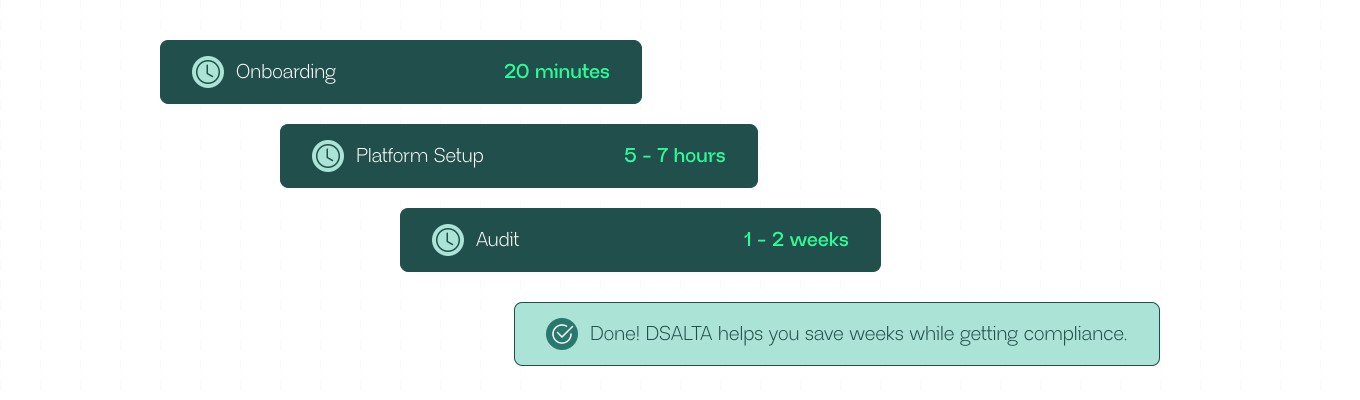
Get it faster with DSALTA.
Get NIST AI RMF aligned in no time with DSALTA.
Fast, simple, auditable.